









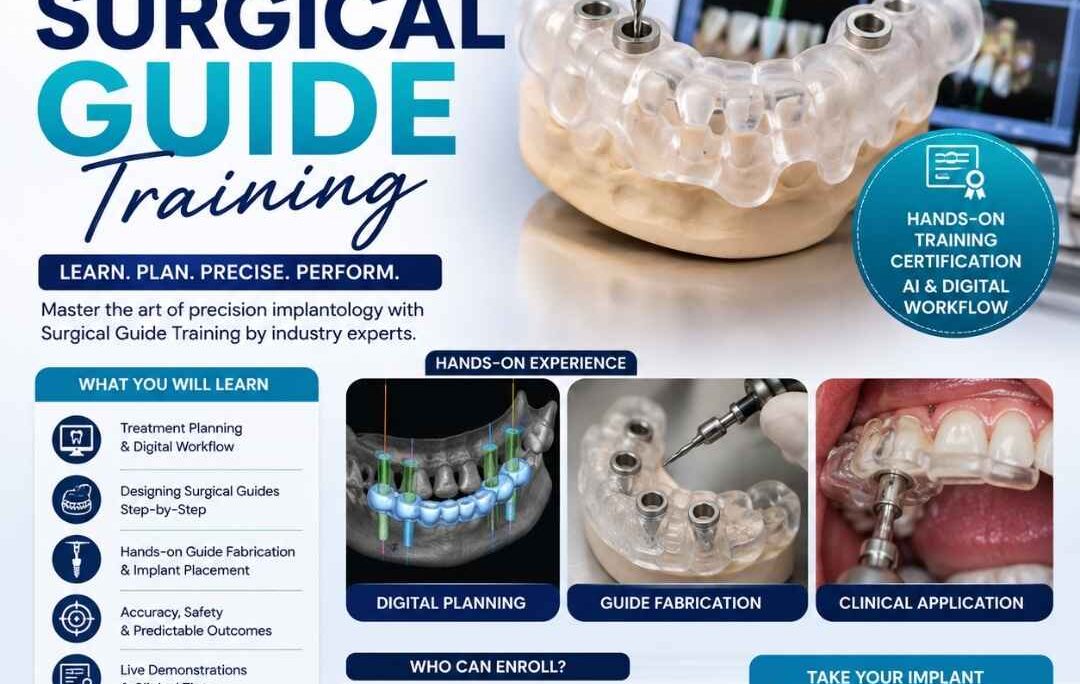
Surgical Guide Training
Dental implant treatment has come a long way. With tools such as CBCT scans, intraoral scanners, digital planning software, and 3D printing, dentists can now plan implant cases in much greater detail before treatment begins. Surgical Guide Training helps dental professionals understand how these technologies fit together and how a digital plan can guide the actual surgical procedure. For Canadian dentists who want to strengthen their implant skills, learning this workflow can be a useful addition to continuing dental education.
A surgical guide isn’t there to make clinical decisions for the dentist. Think of it as an extra tool that helps bring a carefully planned implant position into the surgical setting. The dentist still needs to assess the patient, understand the anatomy, select the right case, and make the final clinical decisions.
Why Surgical Guide Training Matters in Modern Implant Dentistry
Placing an implant isn’t simply a matter of finding enough space in the jaw. There are several things to think about, including bone volume, nearby anatomical structures, soft tissue, the patient’s bite, and where the final crown or prosthesis needs to sit.
Digital planning brings much of this information together. A dentist can view three-dimensional images, examine the proposed implant position, and consider how the implant will work with the final restoration before treatment starts.
For Canadian dental professionals, these skills are becoming increasingly relevant as digital implant workflows become a bigger part of continuing education. Many programmes now introduce dentists to CBCT interpretation, virtual implant planning, digital case simulation, and prosthetically driven treatment planning.
What Exactly Is a Surgical Guide?
A surgical guide is a customised device designed to help a dentist place an implant according to a previously planned position.
Depending on the design and the case, it may help control aspects such as implant positioning and angulation. But the guide is still only one part of the overall treatment process.
Good planning starts with an accurate diagnosis and appropriate case selection. The guide also needs to seat correctly and be checked before treatment. Technology can make the workflow more organised, but it doesn’t replace clinical judgement.
How Does Guided Implant Surgery Work?
The process usually begins with collecting detailed information about the patient. This might include CBCT images, intraoral scans, photographs, dental records, and details about the proposed restoration.
The digital records can then be brought together using implant planning software. This allows the dentist to assess the available bone, identify important anatomical structures, and virtually position the implant.
After the treatment plan has been reviewed, the surgical guide can be designed and manufactured using the chosen digital workflow.
From Digital Scan to Surgical Guide
A typical workflow may look something like this:
- Patient examination and diagnosis
- CBCT imaging
- Intraoral scanning or digital impressions
- Combining the digital records
- Virtual implant positioning
- Surgical guide design
- Guide manufacturing
- Clinical verification
- Guided implant placement
- Restorative treatment and follow-up
Not every case follows exactly the same process. The workflow can change depending on the software, implant system, available technology, complexity of the case, and the dentist’s preferred approach.
What Do You Learn During Surgical Guide Training?
A useful course should teach more than just how to use implant planning software. Knowing where to click isn’t enough. Dentists also need to understand why an implant is being placed in a particular position and how that position relates to the patient’s anatomy and final restoration.
Depending on the programme, training may cover CBCT interpretation, digital impressions, virtual implant placement, prosthetically driven planning, guide design, and digital case evaluation.
Some programmes also use simulated cases or hands-on exercises. These can be especially helpful because you’re actually working through the planning process rather than simply watching someone else do it.
Understanding Prosthetically Driven Planning
One of the most important ideas in modern implant dentistry is to plan with the final restoration in mind.
Instead of asking only, “Where is there enough bone?” the dentist also considers where the future crown or prosthesis needs to be positioned.
The implant can then be planned around that restorative goal while taking the patient’s anatomy and surgical requirements into account. This helps connect the surgical and restorative sides of implant treatment.
The Role of CBCT in Digital Implant Planning
CBCT provides three-dimensional information that can help dentists understand an implant site before treatment.
During training, dentists may learn how to assess bone availability, identify important anatomical structures, and recognise limitations that could affect implant placement.
his makes CBCT interpretation an important part of digital implant planning. A digital plan is only as useful as the information that goes into it, so understanding the scan properly really matters.
Combining CBCT With Intraoral Scans
CBCT scans provide useful information about bone and underlying anatomy. Intraoral scans, on the other hand, provide detailed information about the teeth and oral surfaces.
When these records are combined, dentists can create a more complete digital picture of the treatment area.
Training can show dentists how these files are aligned and then used in planning software. Once the workflow becomes familiar, moving from scanning to planning and guide design feels much more straightforward.
Who Should Consider Digital Surgical Guide Training?
Digital surgical guide education can be useful for general dentists who want to learn more about implant treatment planning and digital workflows.
It can also be helpful for dentists who already place implants but want to bring a more structured digital approach into their practice.
Your current experience matters, though. Someone who is new to implant dentistry may benefit from learning the fundamentals before moving into complex guided surgery or full-arch digital planning.
What Should Beginners Look For?
If you’re just getting started with digital implant planning, don’t pick a course simply because it advertises the newest technology.
Look for a programme that explains the basics clearly. Ideally, it should cover diagnosis, treatment planning, anatomy, CBCT interpretation, digital scanning, surgical guide principles, and the connection between implant placement and the final restoration.
Hands-on exercises or simulated cases are another useful feature. They give you a chance to work through a case yourself instead of simply sitting through a presentation.
Benefits of Guided Implant Surgery Education for Canadian Dentists
For Canadian dentists, learning digital implant workflows can provide a better understanding of how the different stages of an implant case connect.
Scanning, treatment planning, surgery, and restoration don’t have to feel like completely separate steps. A digital workflow can bring them together into one coordinated treatment process.
This can also make communication with dental laboratories and other members of the dental team easier, particularly when everyone is working from the same treatment plan.
Building Confidence Through Case Planning
Using software doesn’t automatically make someone a better implant dentist. Confidence comes from understanding the reasoning behind each clinical decision.
Working through different cases can help dentists spot anatomical challenges, compare possible implant positions, and think about potential problems before surgery.
A good training course should also encourage questions. Sometimes the most useful part of a course is being able to ask an experienced trainer why they chose one approach instead of another.
What Should You Look for in a Surgical Guide Course?
Choosing the right training programme takes a little research. Start by looking at the trainer’s qualifications, clinical experience, and background in implant dentistry.
Then go through the course curriculum carefully. Does it include real case planning? CBCT interpretation? Digital scanning? Implant positioning? Surgical guide design? Prosthetic planning?
Also check how much practical learning is included. Some programmes are mainly lecture-based, while others include demonstrations, simulations, hands-on exercises, or clinical observation. Don’t assume that a course described as “advanced” will automatically give you hands-on experience.
Software and Technology Matter
Digital dentistry involves a wide range of scanners, planning software, CAD/CAM systems, and manufacturing technologies.
Some courses focus heavily on one particular software platform. Others concentrate on the general principles of digital implant planning.
If your clinic already uses a particular scanner or planning system, it’s worth asking whether the course covers compatible technology. Understanding the general workflow is useful, but learning software that you’ll actually use in practice can make the transition much easier.
Surgical Guide Design and 3D Printing
3D printing has become an important part of many modern dental workflows. Once the implant plan is finalised, a surgical guide can be designed digitally and produced using an appropriate printer or dental laboratory.
Training may introduce dentists to the basic principles of guide design and explain how a virtual treatment plan becomes a physical guide.
But printing the guide isn’t the end of the process. The finished guide still needs to be checked carefully. Its fit, stability, and overall suitability should be confirmed before the surgical procedure.
Why Guide Verification Matters
A digital treatment plan can look perfect on a computer screen, but the physical guide still needs to work properly in the patient’s mouth.
Before surgery, the dentist should check that the guide seats correctly and remains stable. Support, anatomy, guide design, and the planned implant position all need to be considered.
This is an important reminder that digital dentistry doesn’t remove the need for clinical checks. It simply gives dentists another way to plan and manage the treatment.
Can Surgical Guides Make Implant Surgery More Predictable?
Digital planning and guided surgery can create a more organised approach to implant treatment, but they can’t remove every possible risk.
The final outcome still depends on patient selection, diagnosis, treatment planning, surgical skill, guide accuracy, and proper follow-up.
So, it’s better to think of a surgical guide as a useful planning and surgical aid rather than a guarantee of a particular treatment result.
How Can Dentists Apply Their Training After the Course?
Finishing a training programme is just the starting point. The next step is putting what you’ve learned into practice with cases that match your experience.
Begin with cases you feel comfortable assessing and planning. Take time to review each stage of the digital workflow. If you come across a difficult case, discussing it with an experienced colleague or mentor can also be valuable.
As you work through more cases, you’ll get a clearer idea of when guided workflows make sense and when another approach might be more suitable.
Keep Learning After the Course
Digital dentistry doesn’t stand still. New scanners, software, planning systems, and manufacturing techniques continue to appear.
Because of that, one training course shouldn’t be treated as the finish line. Regular continuing education, case reviews, professional discussions, and evidence-based learning can help dentists keep their skills and knowledge up to date.
The goal isn’t to use technology simply because it’s available. It’s to know when that technology can genuinely improve planning, communication, efficiency, or patient care.
A Message from Dr. Sharad Arya, Founder – Esthetica Dental Academy
When I started Esthetica Dental Clinic in 2012, my vision was simple — to combine clinical excellence with genuine patient care. Over the years, as our practice grew across Punjab, Himachal, and Chandigarh, I realized that the biggest gap in Indian dentistry wasn’t a lack of talent, but a lack of accessible, hands-on implant training for practicing dentists.
That’s why we built Esthetica Dental Academy — not as another certificate mill, but as a mentorship-driven program where dentists actually work on live cases, under supervision, until they’re confident enough to do it on their own. I’ve seen BDS graduates walk in unsure of their surgical skills and walk out ready to plan and execute full-arch implant cases independently.
If you’re serious about growing your implant practice, I’d encourage you to invest in training that prioritizes real clinical exposure over theory alone. That’s the philosophy behind everything we teach here.
— Prof. Dr. Sharad Arya, MDS
Every batch we train is small by design, because implant surgery demands individual attention, not a classroom of fifty watching a screen. Whether it’s digital implant planning, guided surgery, or full-arch rehabilitation, we make sure every participant leaves confident enough to apply it in their own practice.
Frequently Asked Questions
1. What is a surgical guide in implant dentistry?
A surgical guide is a customised device that helps transfer a digitally planned implant position to the surgical field. It can assist with positioning, but it doesn’t replace proper diagnosis, treatment planning, or clinical judgement.
2. What is taught in a guided implant surgery course?
Course content varies, but training may include CBCT interpretation, digital scanning, virtual implant planning, prosthetically driven treatment planning, surgical guide design, digital workflows, and case assessment.
3. Is surgical guide training suitable for beginners?
It can be, as long as the course covers the necessary fundamentals. Dentists who are new to implant dentistry should choose training that matches their current experience rather than jumping straight into highly complex cases.
4. Do I need to know CAD/CAM before taking the course?
Not necessarily. Many courses introduce the relevant digital workflow as part of the programme. However, having some basic knowledge of digital dentistry can make advanced software exercises easier to understand.
5. Is guided implant surgery better than freehand surgery?
Neither method is automatically better for every case. The appropriate approach depends on the patient, treatment plan, clinician’s experience, technology available, and other clinical factors. A surgical guide should be viewed as an aid, not a replacement for clinical judgement.
6. What technology is used in digital surgical guide training?
Depending on the course, dentists may work with CBCT imaging, intraoral scanners, implant planning software, CAD/CAM systems, digital libraries, and 3D-printing workflows.
7. Can Canadian dentists take implant planning courses?
Yes. Canadian dentists can explore continuing education programmes offered by universities, professional organisations, and dental education providers. Before registering, it’s a good idea to check the course content and make sure it fits your individual professional development goals.
Conclusion
Surgical Guide Training can help dentists understand the journey from diagnosis and digital scanning to virtual implant planning, guide design, and the surgical procedure. For Canadian dental professionals, developing skills in CBCT interpretation, intraoral scanning, virtual implant positioning, prosthetically driven planning, and guide verification can be a useful part of continuing education. Technology can make the process more organised, but good clinical judgement remains essential at every stage. Dentists who want to develop their digital implant skills can explore suitable training opportunities through Esthetica Dental Clinic and should confirm the latest programme details, eligibility, practical training, and applicable professional requirements before enrolling.