









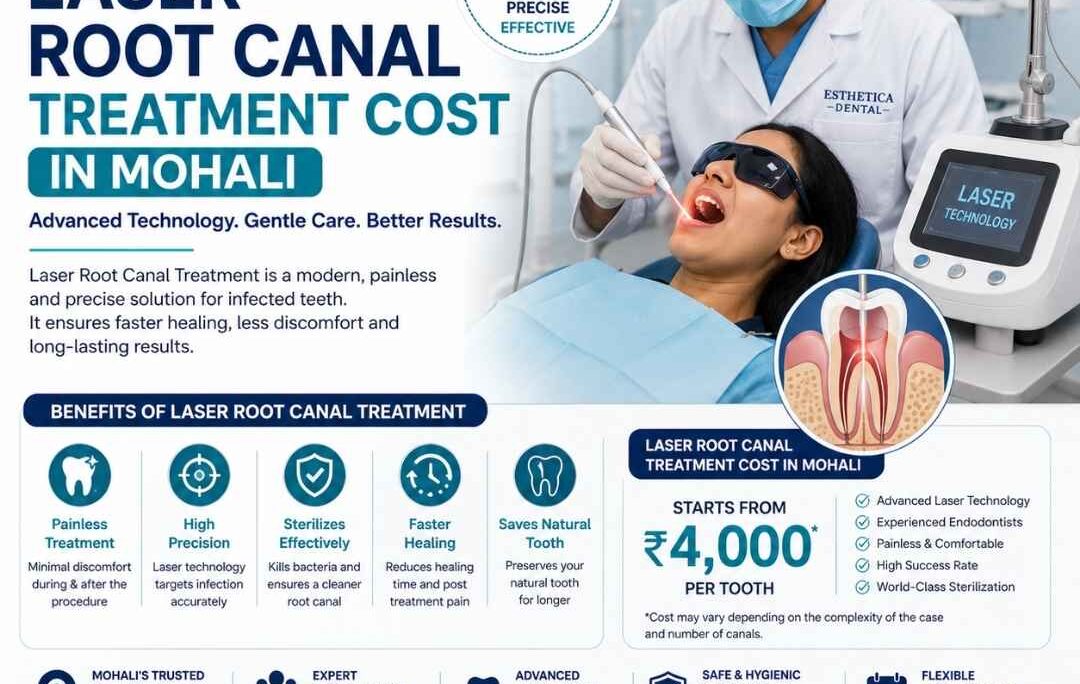
Laser Root Canal Treatment Cost in Mohali
Tooth pain has a way of taking over your whole day. One minute you’re fine, the next you can’t chew on one side of your mouth, and suddenly you’re googling everything from home remedies to emergency dentists at midnight. If a dentist has already told you that you need a root canal, your very next question is probably the one that brought you here: what’s the laser root canal treatment cost in Mohali, and is it actually worth it compared to the traditional method?
This blog breaks it down in plain language — the pricing, the process, and why so many patients today are specifically searching for painless laser root canal treatment instead of the old-school version their parents may have had done years ago.
What Is Laser Root Canal Treatment and Why Is It Different?
Traditional root canal treatment has a reputation problem. Ask anyone over 40 what comes to mind when they hear “root canal,” and you’ll likely get a wince in response. That reputation, fair or not, comes from older techniques that involved more discomfort, longer chair time, and a slower healing process.
Laser root canal treatment in Mohali changes that experience almost entirely. Instead of relying purely on manual instruments, dentists use a focused laser to clean out infected or inflamed tissue inside the tooth’s root canal system, disinfect the area more thoroughly, and prepare it for filling. The laser reaches into the tiny canals more precisely, reduces bacterial load significantly, and causes far less trauma to the surrounding tissue.
The result? Less swelling after treatment, quicker healing, reduced chances of reinfection, and — the part most patients care about most — noticeably less pain during and after the procedure.
Laser Root Canal Treatment Cost in Mohali: What Actually Affects the Price
This is the question everyone’s really asking, so let’s get straight to it. There’s no single fixed number that applies to every patient, and any clinic that quotes you an exact price without an examination is skipping an important step. That said, here’s what genuinely influences the cost:
1. Which tooth is being treated. Front teeth (incisors) typically have a single root canal, while molars at the back can have two, three, or even four canals. More canals mean more time, more materials, and a higher cost.
2. Severity of infection. A tooth caught early with mild inflammation is far simpler to treat than one with a deep abscess or significant bone involvement. Complex cases sometimes need additional sittings or supporting treatments.
3. Crown requirement. After a root canal, most molars need a crown to protect the treated tooth from cracking under chewing pressure. This is usually priced separately from the root canal itself, and it’s worth asking about upfront so you’re not surprised later.
4. Diagnostic imaging. Digital X-rays or CBCT scans (used for more complex cases) add to the overall cost but are essential for an accurate diagnosis and a predictable outcome.
5. Clinic technology and dentist expertise. A clinic using proper diagnostic lasers, rotary endodontic systems, and rubber dam isolation (the correct clinical protocol) will typically price differently than a clinic cutting corners on equipment.
Generally speaking, patients researching root canal specialist in Mohali clinics will find that laser-assisted treatment costs somewhat more than the conventional method — but the trade-off is fewer follow-up visits, less post-treatment discomfort, and a longer-lasting result. Most patients find that the added investment pays for itself in comfort alone.
Why More Patients Are Choosing Laser Treatment Over Traditional Methods
If you’ve been putting off treatment purely out of fear, you’re not alone. Dental anxiety is one of the most common reasons people delay care until the pain becomes unbearable — and by then, the tooth’s condition has usually worsened, making treatment more complicated than it needed to be.
Painless laser root canal treatment has genuinely changed this pattern for a lot of patients. Because the laser reduces the bacterial count more effectively and causes less mechanical trauma to the tooth structure, most people report mild sensitivity at most, rather than the sharp, lingering discomfort associated with older techniques.
There’s also a practical time factor. Laser-assisted procedures often require fewer sittings because the disinfection is more thorough on the first pass, which matters a lot if you’re someone juggling a busy work schedule or traveling from outside the city for treatment.
What Happens During the Procedure?
For anyone nervous about what’s ahead, here’s a simple walkthrough of what a typical laser root canal appointment looks like:
- Diagnosis and X-ray to confirm the extent of infection and map out the canal structure
- Local anesthesia to numb the area completely before any instrumentation begins
- Access opening created in the tooth to reach the root canal system
- Laser-assisted cleaning and disinfection of the infected pulp tissue and bacteria inside the canals
- Shaping of the canals using fine endodontic instruments for a precise, clean structure
- Filling and sealing of the canal space to prevent future reinfection
- Crown placement (usually in a follow-up visit) to restore full chewing function
Most straightforward cases are completed in one to two sittings, while more complex infections may need a couple of additional visits for monitoring before the final filling.
Choosing the Right Root Canal Specialist in Mohali
Cost matters, but it shouldn’t be the only factor guiding your decision. A root canal specialist in Mohali with proper endodontic training, updated sterilization protocols, and modern laser equipment will generally give you a more predictable, longer-lasting outcome than choosing purely based on the lowest quoted price.
Ask about the dentist’s experience with laser-assisted procedures specifically, request to see the equipment being used, and don’t hesitate to ask for a written treatment plan with a cost breakdown before you begin. A transparent clinic will walk you through every step without hesitation.
This is exactly the approach followed at Esthetica Dental Clinic, where treatment plans are explained clearly before any procedure begins, and patients are given a full cost breakdown so there are no surprises later in the process.
Is Laser Root Canal Treatment Worth the Investment?
If you’re weighing the cost against the alternative — living with ongoing pain, risking tooth loss, or eventually needing a more expensive extraction and implant — laser root canal treatment is almost always the more economical choice long term. Saving your natural tooth preserves your bite alignment, avoids the need for replacement options later, and protects your overall oral health.
At Esthetica Dental Clinic, patients are guided through a detailed, judgment-free consultation to understand exactly what their treatment will involve and what it will cost, with no pressure to decide on the spot.
Frequently Asked Questions
1. How much does laser root canal treatment cost in Mohali?
Cost varies based on the tooth involved, severity of infection, and whether a crown is needed afterward. A proper quote can only be given after an in-person examination and X-ray.
2. Is laser root canal treatment painful?
Most patients report significantly less discomfort compared to traditional methods, thanks to reduced tissue trauma and more thorough disinfection.
3. How long does a laser root canal procedure take?
A straightforward case typically takes one to two sittings, each lasting roughly 45 minutes to an hour.
4. Can a root canal be done in a single visit?
Yes, many single-canal or moderately infected cases can be completed in one visit, though multi-canal or severe infections may need additional appointments.
5. Is laser root canal treatment better than traditional root canal treatment?
Laser-assisted treatment generally offers better disinfection, less post-treatment sensitivity, and faster healing compared to conventional instrumentation alone.
6. Do I need a crown after a root canal?
Most back teeth (molars and premolars) need a crown afterward to prevent fracture under normal chewing pressure, since the tooth structure is weaker after treatment.
7. How do I find a good root canal specialist in Mohali?
Look for a dentist with specific endodontic training, updated laser and sterilization equipment, and a track record of transparent, patient-first treatment planning.
Final Thoughts
Putting off a root canal out of fear or cost concerns usually ends up costing more — both financially and in terms of your comfort — down the line. Laser-assisted treatment has made the entire process faster, more comfortable, and more predictable than ever before. If you’re dealing with persistent tooth pain and searching for reliable, transparent care, a consultation is the best first step toward finally getting it resolved.