









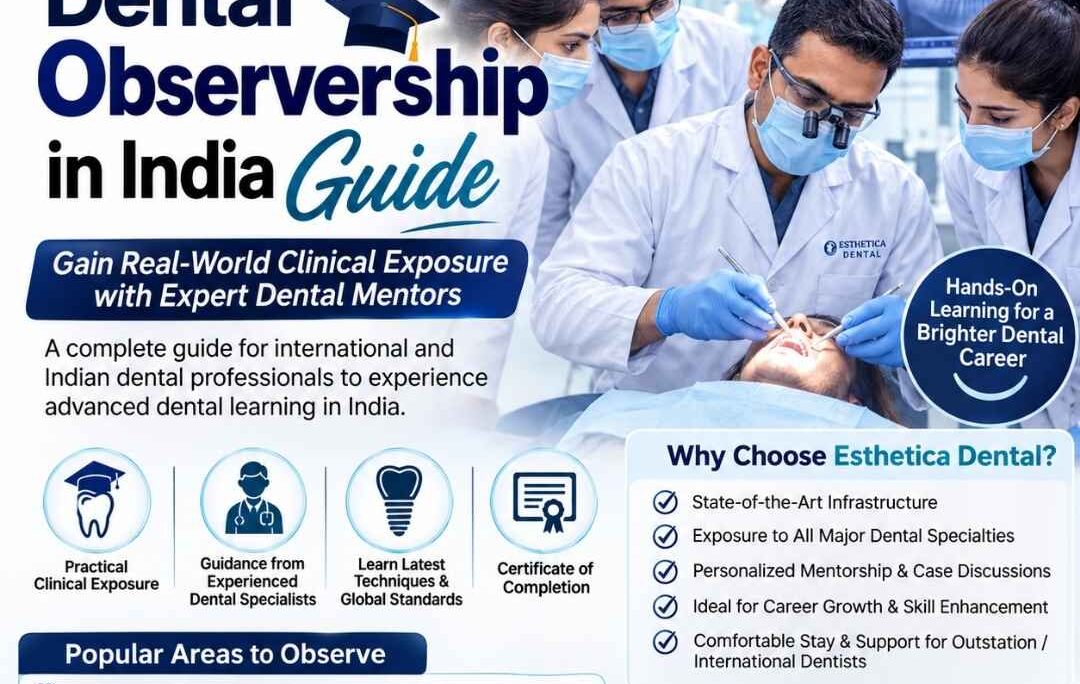
Dental Observership in India Guide
If you’re a dentist trained abroad — in Canada, the US, the UK, or anywhere else — chances are you’ve heard about how valuable hands-on exposure can be before writing licensing exams or applying for residency. A Dental Observership in India has become one of the most talked-about routes for international dentists who want real clinical exposure without the red tape of full local licensing. It’s practical, affordable, and gives you a front-row seat to advanced dental procedures performed by experienced specialists. Let’s break down what it actually involves, who it’s for, and how to pick the right program.
What Exactly Is a Dental Observership Program?
At its core, an observership means shadowing qualified dentists in a live clinical setting — watching diagnosis, treatment planning, and procedures unfold in real time. You’re not performing treatments yourself; instead, you’re absorbing technique, patient communication, and workflow from professionals who do this every day. For many dentists, this bridges the gap between textbook theory and the realities of a working chairside environment, especially useful before attempting licensing exams back home.
Why a Clinical Dental Observership in India Appeals to Global Dentists
India has quietly become a hotspot for dental education tourism, and it’s not hard to see why. Costs are a fraction of what similar exposure would run in North America or Europe, yet the quality of clinical work rivals top international standards. Indian dental centers often handle a high volume of complex cases — implants, full-mouth rehabilitation, cosmetic dentistry, and root canal therapy — giving observers exposure to case diversity that’s harder to find elsewhere. Add in English-speaking staff, modern equipment, and flexible scheduling, and it’s easy to understand the growing interest from overseas dentists.
Who Should Consider a Dental Observership Program for International Dentists?
This path tends to suit a specific group of people. Recent graduates who haven’t yet started practicing independently often use it to build confidence around real patients. Dentists preparing for equivalency exams abroad — such as those required in Canada or the US — use it to sharpen their clinical eye before test day. Practicing dentists looking to pick up newer techniques, like digital implant planning or laser-assisted procedures, also find real value here. And NRI dentists visiting India often combine the experience with reconnecting with family and exploring familiar clinical settings back home.
What Does a Typical Program Actually Cover?
Most structured programs run anywhere from a few days to several weeks, depending on how deep you want to go. Expect direct observation of implant placements, root canal procedures, smile design consultations, orthodontic case reviews, and prosthetic workflows. Good programs also include case discussions, CBCT scan reviews, and time with mentors who can answer questions in detail rather than rushing through appointments. The best setups strike a balance between structured teaching sessions and unscripted, real clinical moments — because that’s where the genuine learning happens.
How to Choose the Best Dental Observership Training in India
Not every program delivers the same value, so it pays to be selective. Start by checking how many years the clinic or academy has been operating and whether its mentors hold recognized postgraduate qualifications. Ask about the case mix you’ll actually see — a program heavy on routine cleanings won’t teach you much compared to one exposing you to full-arch rehabilitation or advanced cosmetic work. Look into group size too; smaller cohorts almost always mean more one-on-one time with your mentor. Finally, read reviews from past participants, ideally other international dentists who’ve gone through the same journey you’re considering.
Planning Your Trip: Duration, Documentation, and Daily Life
Before booking anything, sort out the practical side. Most observership programs ask for basic documentation — proof of your dental degree, a passport copy, and sometimes a short statement of intent. Duration is flexible; some dentists opt for an intensive one-week immersion, while others prefer a month-long stay to see a wider range of cases across seasons and patient types. Accommodation, local transport, and even weekend travel are often easy to arrange around your clinical hours, making the trip feel like a genuine working holiday rather than a rigid academic obligation.
A Growing Number of Canadian Dentists Are Choosing This Route
Interest from Canada has picked up noticeably in recent years. Many Canadian-trained or internationally-educated dentists preparing for NDEB equivalency assessments find that hands-on exposure in India complements their exam prep in ways textbooks simply can’t. The lower cost of living, direct flights from major Canadian cities, and the chance to see high case volumes in a short window make it a practical addition to an already demanding exam-prep schedule.
Final Thoughts on Choosing the Right Program
Ultimately, the value of any observership comes down to the quality of mentorship and the breadth of cases you’re exposed to — not just the number of days on a certificate. Programs like the one offered by Esthetica Advanced Dental Academy are built around exactly that philosophy: real cases, experienced mentors, and small-group learning designed to give international dentists genuine clinical confidence before they head back to their home countries.
A Message from Dr. Sharad Arya, Founder – Esthetica Dental Academy
When I started Esthetica Dental Clinic in 2012, my vision was simple — to combine clinical excellence with genuine patient care. Over the years, as our practice grew across Punjab, Himachal, and Chandigarh, I realized that the biggest gap in Indian dentistry wasn’t a lack of talent, but a lack of accessible, hands-on implant training for practicing dentists.
That’s why we built Esthetica Dental Academy — not as another certificate mill, but as a mentorship-driven program where dentists actually work on live cases, under supervision, until they’re confident enough to do it on their own. I’ve seen BDS graduates walk in unsure of their surgical skills and walk out ready to plan and execute full-arch implant cases independently.
If you’re serious about growing your implant practice, I’d encourage you to invest in training that prioritizes real clinical exposure over theory alone. That’s the philosophy behind everything we teach here.
— Prof. Dr. Sharad Arya, MDS
Every batch we train is small by design, because implant surgery demands individual attention, not a classroom of fifty watching a screen. Whether it’s digital implant planning, guided surgery, or full-arch rehabilitation, we make sure every participant leaves confident enough to apply it in their own practice.
Frequently Asked Questions
1. What is the duration of a typical dental observership in India?
Programs usually range from one week to one month, depending on how much clinical exposure you’re looking for.
2. Do I need a dental license to join an observership program?
No, observerships are designed for shadowing and learning, so you don’t need local licensing to participate.
3. Can dental observership help with NDEB or ADC exam preparation?
Yes, many dentists use it specifically to sharpen clinical judgment before writing equivalency exams abroad.
4. Is a dental observership in India expensive compared to other countries?
It’s generally far more affordable than similar programs in North America, Europe, or Australia.
5. Will I get to perform procedures during the observership?
No, observerships are strictly hands-off; you watch and learn rather than treat patients directly.
6. Is prior clinical experience required to join?
Most programs welcome recent graduates as well as experienced dentists, so prior experience isn’t mandatory.
7. Can international dentists from Canada easily travel for this program?
Yes, with direct flights from major Canadian cities and flexible scheduling, it’s a manageable trip to plan around exam preparation timelines.