







All-on-6 Implant Training in India for New Zealand Dentists
Choosing advanced implant training can be an important consideration for dentists looking to evolve from implantology to complete full-arch rehabilitation. All on 6 implant training in India for New Zealand dentists can provide focused understanding of the diagnosis, treatment planning, surgery as well as prosthetic coordination. Esthetica Dental Academy approach is focused on hands-on education, mentorship as well as clinical cases. All on 6 implant training in India for New Zealand dentists can thus enable clinicians to explore full-arch workflows in a supervised learning environment. The focus should remain on professional development as well as applying knowledge within one’s registration and local requirements.
Why All-on-6 training matters
This approach can connect theory to clinical thinking while providing a better understanding of responsibilities involved in complex full-arch rehabilitation. All-on-6 rehabilitation is more than just understanding the location of six implants. To manage such a case, a clinician needs to be aware of patient selection, available bone, prosthetic space, occlusion, implant positioning, primary stability, as well as the interplay between surgical and restorative decisions.
A foreign dentist can benefit from such a learning curve as it allows to understand the practical aspects of the case rather than isolated procedures. Participants can go through a case from diagnosis and treatment planning as well as discuss surgical and prosthetic decisions. This can provide with a better understanding of full-arch treatment in practice.
What New Zealand dentists can learn
A focused All-on-6 program can cover CBCT interpretation, case assessment, implant positioning, the biomechanics of full-arch rehabilitation as well as multi-unit abutments, temporary prostheses, occlusal considerations as well as concepts related to immediate-loading.
Surgical planning can also be an important component where the impact of anatomical limitations on implant positioning as well as the need to modify treatment planning during surgery can be discussed. Real cases are not always as clear-cut as the diagrams indicate and understanding the nuances of clinical thinking is an invaluable lesson.
Restorative dentistry should get similar attention as it is the restorative aspect that drives the surgical planning. Discussing impression techniques, bite registration, principles of temporary restorations as well as occlusal management can provide a better understanding of how the final restoration can influence the treatment.
Hands-on exposure and clinical mentorship
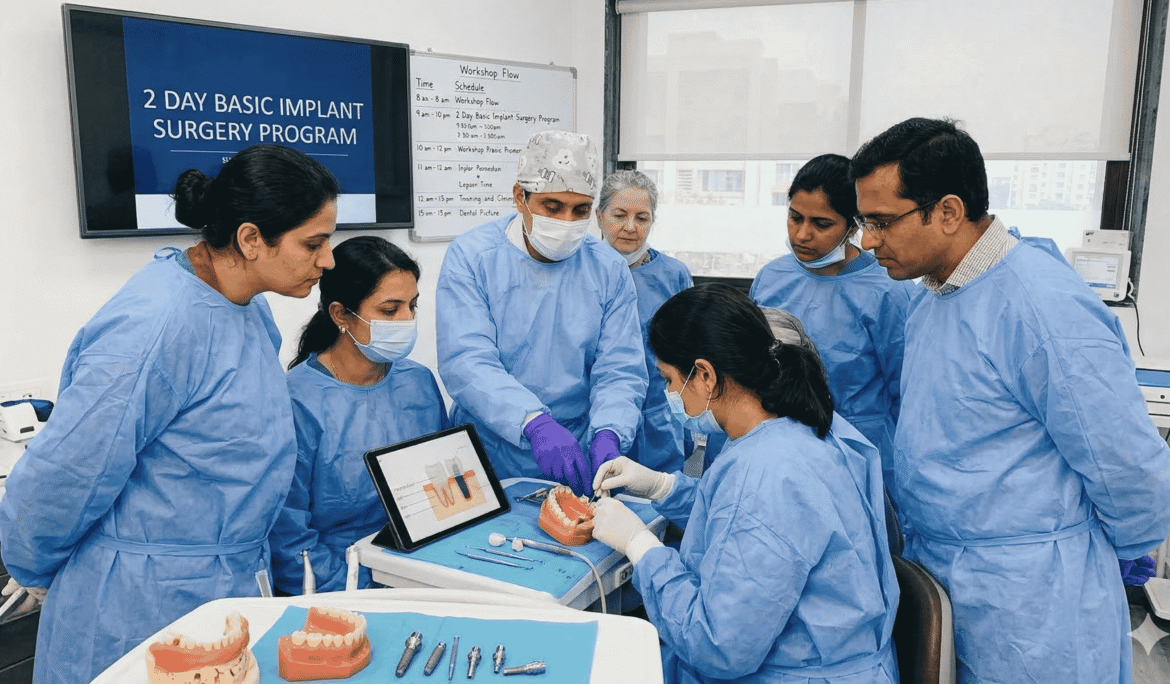
One of the biggest differences between theoretical education and a clinical environment is the ability to observe the decision-making processes around real patients. Esthetica Dental Academy refers to their implant education as mentorship as they encourage live surgery as well as practical exposure in their clinical setting. Small-batch learning is also promoted to enable participants to receive sufficient attention throughout their learning curve.
The hands-on education has another purpose however: To avoid over-promising and create unrealistic expectations regarding practice-ready competence following a short clinical course. Clinical competency is acquired through training, supervision, experience as well as the choice of cases and continues with further education and professional development. All on 6 implant training in India for New Zealand dentists should thus be viewed as an educational opportunity that promotes lifelong learning.
Understanding the full-arch workflow
A proper All on 6 implant training in India for New Zealand dentists experience will discuss the complete workflow. It will begin with patient assessment and diagnosis as the medical history, periodontal condition, bone volume and anatomy, expectations and restorative requirements are all factors in the selection of the case.
CBCT imaging can be utilised to aid the three-dimensional assessment and treatment planning. The clinician can discuss implant positions, angulation, available bone, prosthetic space as well as the restoration. Surgical guides or digital approaches should also be discussed where applicable.
The surgery itself can teach about flap design, osteotomy preparation, implant positioning, primary stability as well as multi-unit abutment considerations. If a case involves immediate-loading, the interplay between surgical stability and the provisional restoration is of special relevance.
Why India can be a practical training destination
India offers international programs that incorporate clinical exposure as well as thorough discussions of the subject. For the New Zealand dentist, the opportunity to spend concentrated time in a clinical environment can be very different compared to a short theoretical workshop.
Esthetica Dental Academy offers a range of implant programs for international dentists that also include options for full-arch rehabilitation such as All-on-6 training. Published course information includes case selection, CBCT planning, implant positioning, surgical training, prosthetic workflow as well as patient exposure. The duration of the course as well as the amount of live exposure can vary significantly, so it is recommended to double-check the current offering prior to making travel arrangements.
Preparing before travelling from New Zealand
Before making bookings, it is important to confirm the course schedule, number and type of cases, hands-on participation, supervision, instruments, accommodation as well as certificate details. Dentists should also be clear on whether the program relates to continuing professional development as opposed to a qualifying examination to gain registration.
New Zealand dentists should also double-check requirements with the Dental Council of New Zealand as well as any applicable employer, insurance or other obligations prior to incorporating techniques learned overseas in one’s practice. Training can extend one’s knowledge, but local requirements should always be taken into account.
Choosing the right training approach
Beyond marketing fluff, it is important to ask more practical questions: How much live surgery is incorporated? Is there supervision? Are cases discussed pre-surgery? Does the course include prosthetic planning? What happens if the case is not straight forward? Are there challenges or complications? A dentist can make an informed choice on what they will be learning based on these factors.
All on 6 implant training in India for New Zealand dentists can be a useful experience in one’s learning curve when the course content aligns with one’s experience and professional development goals. The quality of learning should be impacted by the extent of one’s exposure, clinical mentorship, structured teachings as well as the ability to discuss real cases.
Frequently Asked Questions
1. Who can consider All-on-6 training?
Practicing dentists with relevant implantology experience or foundational knowledge can consider advanced full-arch training. Requirements vary between programs.
2. Is the training suitable for New Zealand dentists?
Yes, international dentists can consider programs aimed at overseas professionals. Eligibility and course content should be discussed prior to travel.
3. Does the program include live patient training?
Published information for Esthetica Dental Academy includes live patient surgery and hands-on exposure in a clinical setting. Details on cases and involvement should be clarified prior to enrollment.
4. What topics are usually covered?
Typically, these programs will discuss CBCT planning, case selection, implant positioning, surgical protocols, multi-unit abutments, immediate loading, temporisation and prosthetic workflow.
5. Is All-on-6 the same as All-on-4?
No, All-on-6 and All-on-4 are unique concepts with regard to full-arch implant rehabilitation. Different numbers of implants are indicated and case selection should be individualised.
6. Will the course provide New Zealand registration?
Training does not automatically provide qualifications or authorisation to practice in New Zealand. Applicable requirements should be researched separately.
7. What should I confirm before booking?
Ask about the duration, live cases, participation, supervision, curriculum, fees, accommodation, travel support, certification and current professional requirements before making travel arrangements.
Final Thought
Advanced implant dentistry is a field of knowledge, planning, supervised practice and experience. For New Zealand dentists, All on 6 implant training in India for New Zealand dentists can provide a concentrated experience in exploring full-arch rehabilitation as well as clinical decision-making. Esthetica Dental Academy offers a training approach focused on practical exposure and mentorship. It is important to make an educated choice based on one’s existing experience as well as realistic expectations of benefits. Prior to travel, it is important to confirm current curriculum, clinical participation, costs and requirements to ensure the experience is well planned and beneficial.
Start Your All-on-6 Implant Training Journey
Considering All on 6 implant training in India for New Zealand dentists? Connect with the training team to understand the course structure, clinical exposure, hands-on learning, mentorship, eligibility, and training schedule. Get the information you need to plan your advanced implantology learning experience in India.
Choose Your Smile Design Program
Select a training format according to your clinical experience, goals and available time.
2-Day Smile
Design
A focused introduction to aesthetic analysis, digital planning and smile design fundamentals.
- Smile analysis
- Digital planning concepts
- Dental photography
- Mock-up concepts
- Aesthetic treatment planning
- Certificate
WhatsApp →
Advanced Smile
Design
Comprehensive training covering smile analysis, digital planning, veneer and aesthetic workflows.
- Digital smile design
- Facial analysis
- Photography protocols
- Mock-up & trial smile
- Veneer case planning
- Hands-on exercises
- Patient communication
WhatsApp →
Aesthetic
Dentistry Program
A deeper clinical program for dentists looking to expand their aesthetic treatment workflow.
- Advanced smile analysis
- Veneer planning
- Anterior aesthetics
- Occlusion concepts
- Digital workflow
- Clinical case discussion
- Mentorship
WhatsApp →
Customize Your
Course
Create a Smile Design training program around your specific clinical requirements.
- Choose training duration
- Select clinical topics
- Digital smile design
- Veneer-focused training
- Hands-on requirements
- Individual mentorship options