









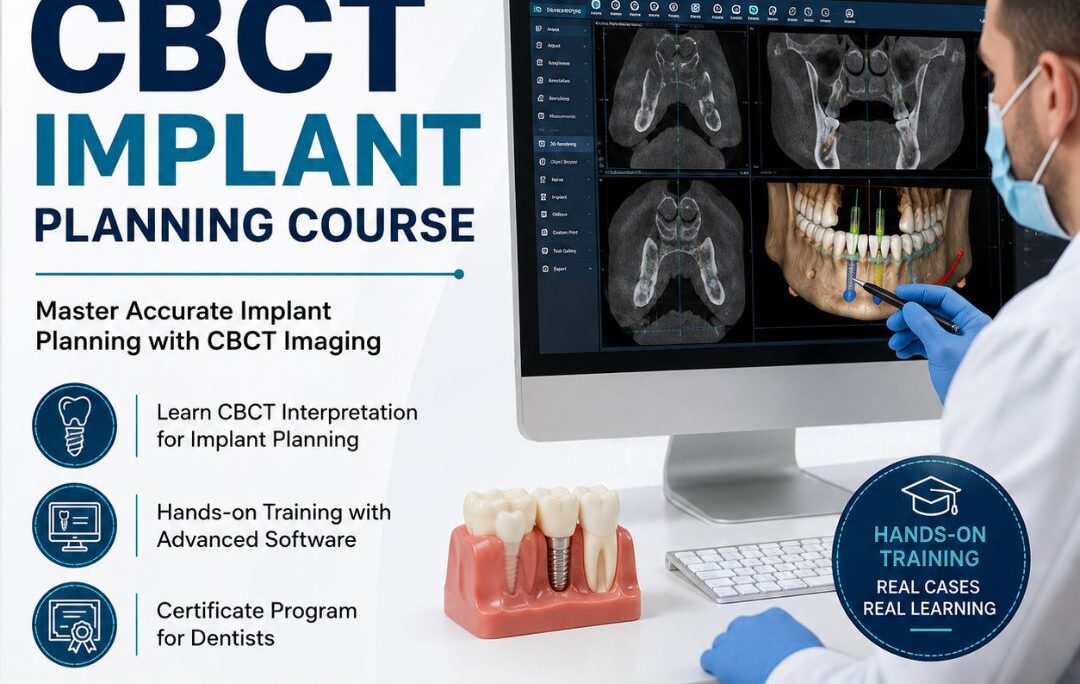
CBCT Implant Planning Course
Every successful implant case is won or lost long before the surgery begins. The real difference between a guesswork placement and a predictable, long-lasting result lies in accurate 3D diagnosis. This is exactly where a CBCT Implant Planning Course becomes a game-changer for dentists who want to move from conventional guesswork to digitally guided precision. Cone Beam Computed Tomography (CBCT) has transformed implant dentistry by giving clinicians a real-time, three-dimensional view of bone density, nerve pathways, sinus proximity, and available bone volume — information that a flat 2D X-ray simply cannot provide. For dentists who want to reduce surgical risk, avoid complications, and deliver consistent aesthetic outcomes, learning CBCT-based planning is no longer optional. It’s becoming the new clinical standard.
Why Traditional Implant Planning Falls Short
For decades, dentists relied on periapical and panoramic X-rays to plan implant cases. While these tools work for basic diagnosis, they fail to capture the true three-dimensional anatomy of the jaw. Bone width, hidden anatomical structures, and subtle variations in density often go unnoticed until the surgeon is already mid-procedure. This is where many implant failures, nerve injuries, and sinus perforations originate — not from poor surgical hands, but from incomplete pre-surgical data. A structured Dental Implant Planning Course built around CBCT imaging solves this problem at its root. It teaches dentists how to read cross-sectional slices, measure bone height and width accurately, identify vital structures, and simulate implant positioning virtually before ever picking up a drill. This shift from reactive to proactive planning is what separates confident implantologists from hesitant ones.
What You’ll Actually Learn in a CBCT-Focused Program
A well-designed CBCT Training for Dentists program doesn’t just teach software navigation — it builds diagnostic judgment. Participants typically learn how to interpret axial, sagittal, and coronal views, assess bone quality using density scales, and identify anatomical landmarks like the inferior alveolar nerve, mental foramen, and maxillary sinus floor. Beyond diagnosis, most courses cover virtual implant placement using planning software, where dentists can select implant size, angulation, and depth digitally before the actual surgery. Many advanced programs also introduce guided surgery concepts, where a surgical stent is fabricated based on the CBCT-derived plan, allowing for pinpoint accuracy during placement. This hands-on, case-based approach ensures dentists don’t just watch demonstrations — they actively practice planning real clinical scenarios under mentorship.
Who Should Enroll in This Training
This type of training isn’t reserved only for oral surgeons or specialists. General dentists looking to expand their scope of practice, prosthodontists wanting better restorative outcomes, and even recent graduates aiming to build implant confidence early in their careers can all benefit. If you’re a clinician practicing in a competitive region and searching for an Implant Dentistry Course Chandigarh based programs offer, you’ll find that hands-on CBCT training gives you a distinct edge over peers still relying on outdated 2D planning methods. Patients today are more informed than ever, and many specifically ask whether their dentist uses 3D imaging before implant surgery. Being able to answer confidently — and show them the scan — builds trust instantly.
The Real-World Impact on Patient Outcomes
Dentists who complete structured CBCT training report noticeably fewer surgical complications and significantly improved case acceptance rates. When patients see a detailed 3D scan of their own jaw, along with a visual simulation of where the implant will sit, their confidence in the treatment plan increases dramatically. This transparency reduces treatment anxiety and improves informed consent conversations. From a clinical standpoint, accurate pre-surgical planning also reduces chair time, minimizes the need for exploratory flap surgeries, and lowers the risk of nerve damage or sinus complications — all of which directly protect the dentist’s reputation and reduce medico-legal risk. In an era where patients research heavily before choosing a provider, offering CBCT-guided implant planning has become a genuine competitive differentiator, not just a technical upgrade.
How to Choose the Right Training Program
Not all courses are created equal, so dentists should look for programs that combine theoretical learning with live case demonstrations and hands-on software practice. A strong curriculum should cover radiographic interpretation, digital treatment planning workflows, surgical guide fabrication, and troubleshooting common anatomical challenges like limited bone height or proximity to the sinus. Mentorship access matters too — being able to discuss real patient cases with experienced trainers after the course ends adds long-term value that a one-time lecture simply cannot replicate. Small batch sizes, practical case studies, and post-course support are strong indicators of a program designed for genuine skill-building rather than just certificate issuance.
Building Long-Term Confidence in Implant Practice
Mastering CBCT-based planning isn’t a one-time achievement; it’s an evolving skill that improves with every case reviewed and every scan interpreted. Dentists who commit to continuous learning in this space find themselves handling increasingly complex cases with greater ease — from single-tooth replacements to full-arch rehabilitations. The confidence gained from understanding exactly where an implant should sit, rather than estimating it, changes how a dentist approaches every consultation. Over time, this translates into stronger patient relationships, better referrals, and a practice known for precision rather than trial and error. For clinicians serious about advancing their surgical skill set, investing in structured, mentorship-backed training focused on CBCT diagnostics and planning is one of the most valuable steps they can take in their professional journey.
Final Thoughts on Advancing Your Implant Skills
The shift toward digital, data-driven dentistry is not slowing down, and CBCT planning sits right at the center of this transformation. Clinicians who invest time in mastering this skill position themselves as forward-thinking, detail-oriented practitioners in an increasingly competitive field. Training programs that blend academic depth with real clinical exposure, such as those offered by Esthetica Advanced Dental Academy, help bridge the gap between textbook knowledge and confident, real-world implant execution.
A Message from Dr. Sharad Arya, Founder – Esthetica Dental Academy
When I started Esthetica Dental Clinic in 2012, my vision was simple — to combine clinical excellence with genuine patient care. Over the years, as our practice grew across Punjab, Himachal, and Chandigarh, I realized that the biggest gap in Indian dentistry wasn’t a lack of talent, but a lack of accessible, hands-on implant training for practicing dentists.
That’s why we built Esthetica Dental Academy — not as another certificate mill, but as a mentorship-driven program where dentists actually work on live cases, under supervision, until they’re confident enough to do it on their own. I’ve seen BDS graduates walk in unsure of their surgical skills and walk out ready to plan and execute full-arch implant cases independently.
If you’re serious about growing your implant practice, I’d encourage you to invest in training that prioritizes real clinical exposure over theory alone. That’s the philosophy behind everything we teach here.
— Prof. Dr. Sharad Arya, MDS
Every batch we train is small by design, because implant surgery demands individual attention, not a classroom of fifty watching a screen. Whether it’s digital implant planning, guided surgery, or full-arch rehabilitation, we make sure every participant leaves confident enough to apply it in their own practice.
Frequently Asked Questions
1. What is a CBCT implant planning course designed for?
It’s designed to teach dentists how to read 3D scans accurately and plan implant surgeries digitally before the actual procedure, reducing complications and improving precision.
2. Do general dentists need CBCT training, or only oral surgeons?
General dentists benefit significantly, since CBCT skills allow them to confidently diagnose, plan, and even refer complex cases with much greater clarity and detail.
3. How long does a typical CBCT training program take to complete?
Most structured programs run over a few intensive days to a few weeks, combining theory sessions with hands-on practical case planning under mentorship.
4. Is CBCT training available for dentists based in Canada?
Yes, many dentists from Canada join international hands-on programs or hybrid online-practical courses to gain certified CBCT and implant planning skills.
5. What software is commonly used in CBCT implant planning courses?
Popular digital implant planning platforms are typically covered, allowing dentists to simulate implant size, angle, and depth before actual surgical placement.
6. Can CBCT training help reduce implant failure rates?
Yes, accurate pre-surgical 3D planning significantly lowers risks like nerve damage, sinus perforation, or poor implant positioning, which are common causes of failure.
7. Is prior implant experience required before joining a CBCT course?
Not necessarily. Many programs are structured to accommodate both beginners building foundational skills and experienced dentists refining advanced planning techniques.