







For over a decade, the narrative surrounding dental tourism in India has undergone a massive transformation. What once began as a “low-cost alternative” for uninsured patients has evolved into a global benchmark for “high-value digital excellence.” As we move through 2026, the question on the minds of thousands of patients from the USA, UK, Australia, and Canada is no longer just “How much can I save?” but more importantly, “Is it safe?“
The short answer is: Yes, dental tourism in India is safer in 2026 than it has ever been. However, safety is not a generic guarantee—it is a result of choosing clinics that adhere to international accreditation, utilize cutting-edge digital workflows, and maintain transparent clinical protocols. At Esthetica Dental Clinic, we have witnessed this evolution firsthand, growing from a humble practice to a premier dental network serving a global clientele.
In this comprehensive guide, we will break down the safety landscape of Indian dental tourism in 2026, backed by data, clinical standards, and the technological shifts that have made India a “Medical Tourism 2.0” powerhouse.
The Regulatory Shield: NABH and Global Accreditations
In 2026, the primary metric for safety in Indian dentistry is NABH (National Accreditation Board for Hospitals and Healthcare Providers). This accreditation is the Indian equivalent of the Joint Commission International (JCI) and serves as a verified seal of quality.
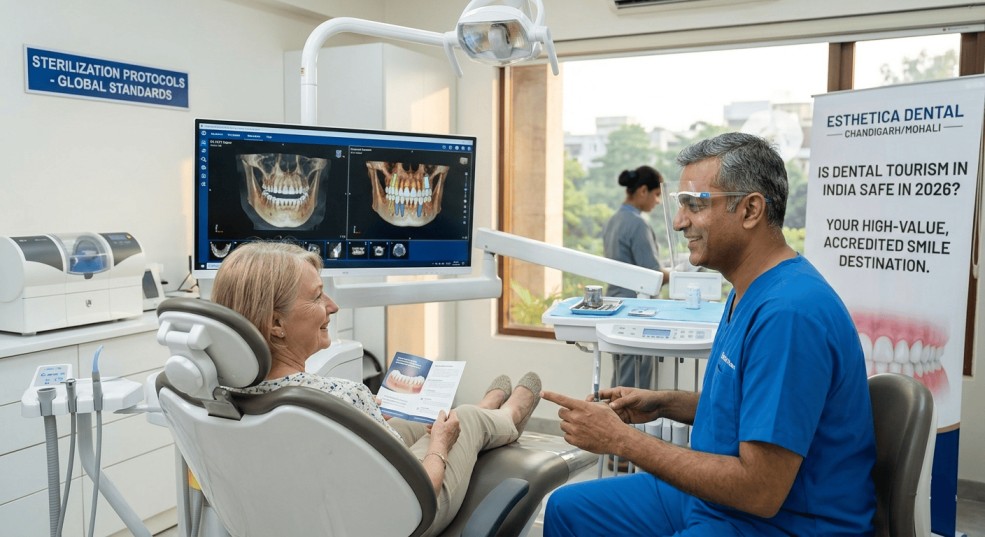
Verified Sterilization: NABH-accredited clinics undergo rigorous inspections of their infection-control systems. This ensures that every instrument used—from high-speed drills to surgical scalpels—undergoes a multi-stage sterilization process that meets global benchmarks.
Staff Accountability: Accreditation ensures that not just the lead dentist, but the entire support staff is qualified and trained in emergency protocols.
Patient Grievance Redressal: Unlike the “Wild West” of unregulated clinics, accredited facilities must have a formal mechanism for addressing patient concerns, providing a layer of security that was often missing in the past.
At Esthetica Dental, our commitment to safety isn’t just about following rules; it’s about setting them. By integrating these high standards, we ensure that an international patient receives the same (or often superior) level of care they would expect in London or New York.
Digital Dentistry: Reducing Human Error
One of the most significant safety advancements in 2026 is the widespread adoption of Digital Workflows. Technology has moved from being a luxury to a safety requirement.
3D CBCT Imaging: Traditional 2D X-rays are no longer enough for complex procedures like dental implants. In 2026, top clinics use 3D Cone Beam Computed Tomography (CBCT) to map out a patient’s bone structure, nerve paths, and sinus cavities with sub-millimeter precision before a single incision is made.
Computer-Guided Surgery: “Blind” surgery is a thing of the past. Using 3D scans, dentists create surgical guides (templates) that dictate the exact angle and depth of an implant. This reduces surgical time, minimizes trauma to the tissue, and ensures faster healing.
CAD/CAM & Same-Day Restorations: For international patients, time is the biggest risk factor. In 2026, chairside milling (CAD/CAM) allows clinics to design and create permanent crowns or veneers in a single day. This eliminates the need for temporary restorations, which are often prone to falling out or causing sensitivity during travel.
The Cost vs. Quality Paradox
A common misconception is that “low cost equals low quality.” In India, the 60–80% cost saving is not achieved by cutting corners on materials. Instead, it is driven by:
Lower Operational Overhead: Real estate and administrative costs are significantly lower in India than in the West.
Professional Fee Disparity: The cost of living allows highly skilled, internationally trained specialists to offer their services at a fraction of Western prices.
In fact, the materials used in top-tier Indian clinics are identical to those used in the USA. Brands like Straumann, Nobel Biocare, and Osstem are the gold standard for implants globally, and they are used daily at Esthetica Dental. Patients in 2026 are increasingly searching for “Implant Passports”—a document that tracks the specific serial number and brand of the material used, allowing for seamless follow-up care anywhere in the world.
Language, Communication, and the “Human” Factor
Safety is not just clinical; it is also about clear communication. One of India’s biggest advantages over competing destinations like Turkey or Mexico is the high proficiency in English.
Informed Consent: In 2026, “Heal in India” initiatives have standardized how treatment plans are presented. Patients receive detailed digital copies of their treatment plans, including risks, benefits, and alternatives, all explained in fluent English.
Remote Consultations: The journey starts long before the flight. Most patients now utilize video consultations and AI-assisted diagnostics to review their cases from their home countries. This “Pre-Travel Planning” ensures there are no surprises upon arrival.
Why Chandigarh/Mohali is a Safety Hub
While cities like Delhi and Mumbai are popular, the Chandigarh-Mohali region (where Esthetica Dental is headquartered) has emerged as a preferred destination for dental tourists in 2026.
Planned Infrastructure: Known as India’s first planned city, Chandigarh offers a clean, low-stress environment that is conducive to post-surgical recovery.
Medical Excellence: The region is a hub for medical education and research, ensuring a high density of award-winning specialists and state-of-the-art facilities.
Managing the Risks: A Checklist for 2026
Despite the advancements, “Safety” remains a collaborative effort between the clinic and the patient. To ensure a safe experience, international patients should look for the following “Safety Pillars”:
| Safety Pillar | What to Look For |
| Accreditation | NABH or ISO 9001:2015 certification. |
| Technology | In-house CBCT and CAD/CAM facilities. |
| Materials | Usage of globally recognized, warrantied implant systems. |
| Transparency | All-inclusive pricing without hidden “tourist taxes.” |
| Timeline | A realistic schedule (e.g., 7–10 days for multiple implants). |
The Esthetica Promise: Safety Beyond Borders
At Esthetica Dental Clinic, we have spent over 14 years refining the patient experience for our global visitors. Our 2026 protocols include:
AI-Enhanced Diagnostics: Using AI to cross-verify X-ray findings for 100% diagnostic accuracy.
Painless Laser Dentistry: Utilizing advanced lasers to reduce the need for anesthesia and stitches, leading to near-instant recovery.
End-to-End Concierge: From medical visa assistance to airport pickups, we ensure that the “tourism” part of dental tourism is as safe and stress-free as the “dental” part.
Conclusion: A New Era of Trust
As we look at the data for 2026, it is clear that India has moved past the era of being a “cheap” destination. It is now a quality destination. With the integration of NABH standards, digital precision, and transparent communication, the safety of dental tourism in India is firmly established.
Whether you are looking for a full-mouth restoration or a simple cosmetic smile makeover, the modern Indian dental clinic is equipped to provide world-class results with a safety profile that rivals any Western institution. Your journey to a healthier smile isn’t just about the destination—it’s about the standard of care you receive.