






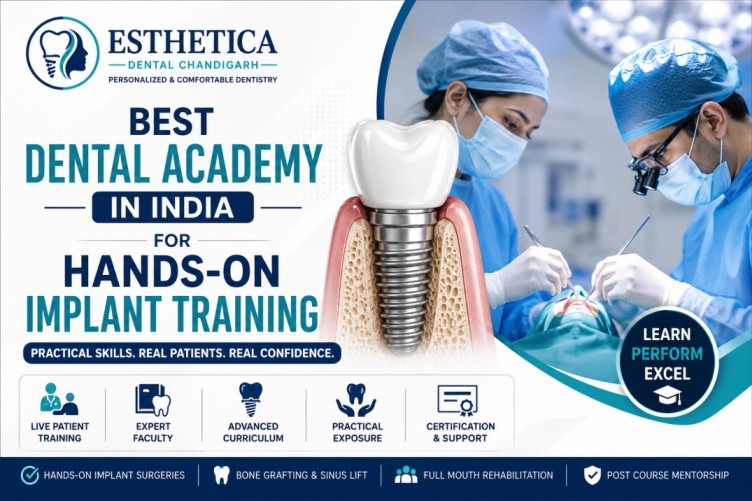
Best Dental Academy in India for Hands-On Implant Training
India has quietly become one of the most sought-after destinations for dentists who want practical, hands-on training instead of purely theoretical coursework. Whether you’re a general dentist or a specialist, choosing the best dental academy in India can make the difference between watching procedures from the back of a lecture hall and actually building the confidence to perform them yourself.
With dental implant treatment growing rapidly across the country, more and more dentists — both Indian and international — are enrolling in structured, mentorship-driven programs to sharpen their clinical skills. Here’s what actually separates a great dental academy from an average one.
What Makes a Dental Academy Worth Your Time
Not every “academy” delivers real clinical exposure. The best programs typically combine:
- Live case demonstrations — where you watch real procedures on real patients, not just simulations
- Small batch sizes — so you get individual mentorship rather than sitting in a crowded lecture hall
- Hands-on implant placement — under close supervision, not just passive observation
- CBCT-guided diagnosis and digital planning — now considered essential in modern implantology
- Case-based discussions — that mirror the real decision-making you’ll face in your own practice
Why Implant-Focused Training Matters
Dental implants remain one of the fastest-growing segments of dentistry, and All-on-6 / full-mouth rehabilitation protocols are increasingly in demand from patients across India and abroad. The best dental academy in India will typically specialize in implant dentistry — covering immediate loading protocols, surgical planning, and prosthetic workflows — producing dentists who feel genuinely confident taking on complex cases back in their own clinics.
Who Should Consider This Kind of Training
- Recent BDS/MDS graduates wanting practical confidence before independent practice
- General dentists looking to add implantology to their service offerings
- Specialists wanting to refine advanced full-arch rehabilitation techniques
- International dentists exploring India’s growing reputation for affordable, high-quality clinical training
Implant Training Should Include Treatment Planning
Implant dentistry is not only about placing an implant. Proper diagnosis and treatment planning are essential before surgery.
A comprehensive training program should teach dentists how to evaluate:
- Medical and dental history
- Available bone volume
- Bone density
- Soft-tissue condition
- Occlusion
- Implant position
- Prosthetic requirements
- CBCT findings
- Patient expectations
Understanding these factors helps dentists make better clinical decisions and develop predictable treatment plans.
Learning Bone Grafting and Sinus Lift Techniques
Some patients may not have sufficient bone volume for conventional implant placement. In such situations, additional procedures may be required.
Advanced implantology programs may introduce dentists to techniques such as:
Bone Grafting: Used to increase or restore bone volume when clinically appropriate.
Guided Bone Regeneration: A technique used to support bone regeneration around deficient areas.
Sinus Lift: A procedure used in selected upper-jaw cases where additional vertical bone height is required.
Ridge Expansion: Used in appropriate cases involving narrow alveolar ridges.
These procedures require careful diagnosis and appropriate supervision during training. Several advanced implant programs currently include these topics as part of their clinical curriculum.
Full Mouth Implant Training
Dentists interested in complex rehabilitation may also consider training that covers full-mouth and full-arch implant concepts.
Full-arch implant training can introduce dentists to:
- All-on-4 concepts
- All-on-X treatment planning
- Tilted implants
- Immediate loading concepts
- Full-mouth rehabilitation
- Multi-unit abutments
- Temporary prosthetic workflows
- Digital treatment planning
- CBCT analysis
Advanced programs may provide clinical exposure to full-arch cases alongside surgical and prosthetic planning.
Different Levels of Implantology Training
Not every dentist needs the same level of training. Choosing a program according to experience can make the learning process more effective.
Beginner Implantology Courses
These programs are suitable for dentists who are new to implant dentistry. They generally focus on implant fundamentals, components, case selection, surgical principles, and basic demonstrations.
Intermediate Hands-On Programs
These courses can provide greater practical exposure and may include supervised implant placement, surgical exercises, case planning, and basic advanced procedures.
Advanced Implantology Programs
Advanced programs are designed for dentists who want broader surgical and prosthetic experience. Depending on the curriculum, they may include multiple live surgeries, bone grafting, sinus lift procedures, implant prosthetics, and full-mouth rehabilitation.
Some current training programs provide multiple live implant surgeries with progressively advanced clinical exposure.
How to Choose the Right Dental Academy in India
Before making a decision, compare academies based on practical learning rather than marketing claims.
Consider these questions:
- How many hands-on sessions are included?
- Are live patient cases available?
- Do participants perform procedures or only observe?
- Is supervision provided during clinical procedures?
- Does the program cover treatment planning?
- Are CBCT and radiographic assessment included?
- Does the curriculum include prosthetic training?
- Are advanced procedures covered?
- Is post-course mentorship available?
- What clinical experience is appropriate for your current skill level?
A transparent academy should clearly explain the course structure, clinical exposure, eligibility, supervision, and expected learning outcomes.
Why Practical Exposure Can Build Clinical Confidence
Confidence in implant dentistry develops gradually. A dentist may understand the surgical protocol but still feel uncertain when faced with a real patient.
Hands-on education can help bridge that gap by allowing dentists to understand how theory translates into clinical practice.
Working through real cases can expose learners to practical considerations such as patient communication, surgical positioning, instrument handling, treatment sequencing, and post-operative care.
The objective should not simply be to complete a course. The goal should be to develop a stronger understanding of implant treatment and know when a particular procedure is appropriate.
Is Hands-On Implant Training Suitable for Fresh BDS Dentists?
Fresh BDS graduates can consider beginner-level implantology training if they meet the program’s eligibility requirements. However, they should choose a course that introduces concepts progressively rather than immediately focusing on highly complex procedures.
Some implant programs specifically accept fresh BDS graduates and provide foundational training before progressing toward advanced clinical procedures.
Dentists should also understand that a training certificate does not automatically replace statutory qualifications, registration requirements, or professional regulations. The scope of clinical practice must always remain within the dentist’s applicable registration and regulatory requirements.
Final Thoughts
Finding the best dental academy in India for hands-on implant training requires more than comparing course names. Dentists should look for practical exposure, supervised clinical experience, structured treatment planning, experienced mentorship, and opportunities to understand both surgical and prosthetic aspects of implant dentistry.
For beginners, a foundation course may be appropriate. Dentists with some implant experience may benefit from programs involving multiple live surgeries, while experienced clinicians may prefer advanced training in full-arch rehabilitation, bone management, or complex implant procedures.
The right training program should ultimately help dentists move from theoretical knowledge toward responsible, evidence-based clinical practice with greater understanding and confidence.