


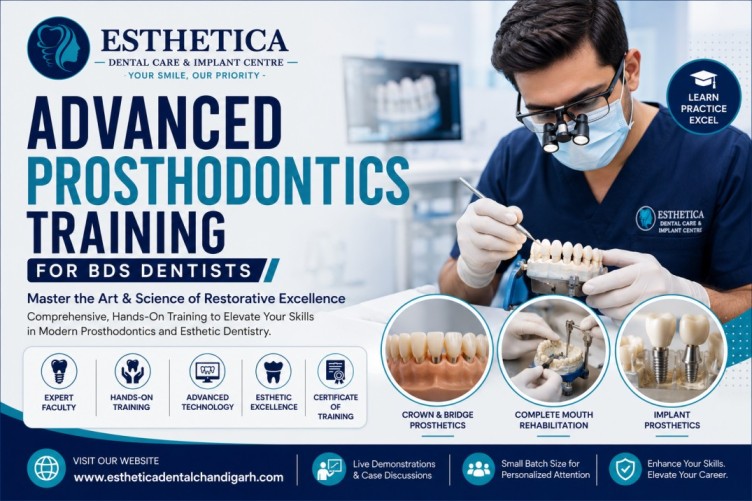
Advanced Prosthodontics Training For BDS Dentists
Prosthodontics combines clinical knowledge, restorative science, aesthetics, and treatment planning to restore damaged, worn, or missing teeth. For BDS dentists, advanced prosthodontics training can provide an opportunity to strengthen practical knowledge and develop greater confidence in restorative procedures. Instead of focusing only on theory, advanced learning can connect diagnosis, treatment planning, preparation, impressions, laboratory communication, provisionalization, cementation, and follow-up into a complete clinical workflow.
A well-structured training program helps dentists understand how each clinical decision can influence the final restoration. Crowns, bridges, veneers, dentures, and other prosthodontic treatments require careful assessment of tooth structure, occlusion, periodontal health, aesthetics, function, and patient expectations. Practical learning can help dentists improve their approach while understanding the indications, limitations, and responsibilities associated with different restorative procedures.
Why Advanced Prosthodontics Training Matters for BDS Dentists
Prosthodontic treatment involves multiple connected stages, and mistakes in one stage can affect subsequent procedures. Advanced training can help dentists understand the complete sequence, from examination and case selection to restoration delivery and maintenance.
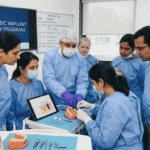
Hands-on education is especially useful because it gives clinicians opportunities to observe procedures, practice techniques, discuss challenges, and receive professional feedback. The objective is not simply to perform procedures but to understand why a particular technique, material, or treatment plan may be appropriate for a specific clinical situation.
A comprehensive program should also emphasize patient safety, infection control, informed consent, communication, appropriate referrals, and post-treatment monitoring. These elements support responsible clinical decision-making and help dentists approach prosthodontic cases with greater consistency.
Tooth Preparation and Restorative Foundations
Tooth preparation is an important foundation of fixed prosthodontics. The preparation must provide adequate space for the chosen restorative material while preserving as much healthy tooth structure as reasonably possible. Factors such as reduction, taper, margin design, occlusal clearance, and surface smoothness can influence the fit and performance of the final restoration.
Advanced training can help BDS dentists understand preparation requirements for different restorative options. Participants may learn to evaluate reduction, identify common preparation errors, and understand how preparation design affects laboratory procedures.
A systematic approach can also improve communication between the dental clinic and laboratory. When preparation principles are clearly understood, dentists can better evaluate the restoration during try-in and delivery.
Crowns for Function and Aesthetics
Crowns are commonly used when a tooth has significant structural damage, large restorations, fractures, or specific functional and aesthetic requirements. Successful crown treatment requires more than creating a preparation. Dentists need to consider occlusion, periodontal condition, remaining tooth structure, contacts, contours, material selection, and marginal integrity.
Advanced prosthodontic education can provide a structured approach to crown preparation and evaluation. Dentists can learn how restorative materials influence preparation requirements and how clinical factors affect the final outcome.
Aesthetic cases require additional attention to shade, contour, proportions, emergence profile, and communication with the laboratory. Functional considerations remain equally important because a restoration should be comfortable and compatible with the patient’s occlusion.
Bridges and Comprehensive Treatment Planning
Fixed partial dentures, commonly known as bridges, require careful planning because supporting abutment teeth play a major role in the success of treatment. Dentists should assess the condition of potential abutments, periodontal health, available restorative space, occlusion, ridge anatomy, and patient expectations.
Training can introduce important aspects such as abutment preparation, path of insertion, pontic design, connector considerations, provisional restorations, impressions, and cementation. Understanding these stages helps dentists appreciate how early treatment decisions can affect the final restoration.
Laboratory communication is also an important part of bridge treatment. Clear records, appropriate impressions, accurate preparation, and effective communication can help improve consistency throughout the restorative workflow.
Veneers and Conservative esthetica Dentistry
Veneers can provide a conservative option for selected anterior aesthetic cases. However, successful treatment depends heavily on case selection and careful planning. Dentists should evaluate enamel availability, tooth position, existing restorations, occlusion, colour, facial proportions, and the patient’s expectations before recommending veneers.
Advanced training may cover smile analysis, conservative preparation, shade selection, temporization, impression techniques, and bonding principles. Dentists can also learn the importance of preserving tooth structure and coordinating effectively with the laboratory.
Patient communication should remain central to aesthetic dentistry. A clear discussion about possible results, limitations, maintenance, and realistic expectations can support better treatment planning and patient satisfaction.
Dentures and Rehabilitation of Missing Teeth
Complete and partial dentures continue to be valuable treatment options for patients with tooth loss. Their success depends on several factors, including support, stability, retention, aesthetics, jaw relationships, impressions, tooth arrangement, and patient adaptation.
Training may cover impression procedures, border considerations, jaw relation records, tooth selection, wax try-in, insertion, and adjustment. Dentists can also learn how to identify common concerns such as discomfort, instability, poor retention, occlusal discrepancies, and fit problems.
Patients may require time to adapt to removable prostheses. Clear instructions regarding insertion, removal, hygiene, eating, maintenance, and follow-up can help improve the overall experience.
Accurate Impressions and Digital Workflows
Impressions provide important clinical information for the fabrication of many prosthodontic restorations. Errors may occur due to unsuitable trays, incorrect material handling, inadequate tissue management, poor mixing, movement during setting, or improper removal.
Hands-on learning allows dentists to become more familiar with conventional impression materials, tray selection, tissue management, impression evaluation, and clinical handling. Advanced programs may also introduce digital impression systems and scanning workflows where appropriate.
Understanding both conventional and digital techniques helps dentists select an approach according to the clinical case, available technology, material requirements, and laboratory workflow.
Cementation and Final Restoration Delivery
Cementation is a critical stage because restoration seating, retention, marginal adaptation, and occlusion can all be affected by the cementation process. Even a well-designed preparation and accurately fabricated restoration require careful delivery.
Advanced training can cover restoration try-in, isolation, cement selection, seating techniques, excess cement removal, and occlusal evaluation. The preferred cementation approach depends on the restoration type, material, preparation characteristics, and manufacturer recommendations.
A systematic delivery protocol can help dentists identify problems before final cementation and ensure that the restoration is properly evaluated before completion of treatment.
Develop Confidence Through Hands On Learning
Clinical confidence develops through knowledge, repetition, feedback, and sound judgment. Practical training gives dentists the opportunity to translate theoretical concepts into clinical techniques while learning from experienced instructors.
Esthetica Dental Academy focuses on practical learning that can help dentists connect prosthodontic concepts with clinical application. Training that combines demonstrations, supervised practice, treatment planning, and feedback can provide a more complete educational experience than theory alone.
Mentorship is particularly useful when dentists encounter unfamiliar cases. It can help them understand when a procedure is appropriate, when additional planning is required, and when referral to a specialist may be more suitable.
Choosing the Right Prosthodontics Training Program
BDS dentists should evaluate several factors when selecting advanced prosthodontics training. A useful program should provide meaningful practical exposure rather than relying entirely on classroom lectures. The curriculum should cover treatment planning, preparation principles, restorative materials, laboratory communication, occlusion, aesthetics, cementation, and patient management.
The quality of supervision also matters. Dentists should have opportunities to ask questions, receive feedback, and understand the reasoning behind different clinical protocols. Attention to infection control, patient safety, informed consent, documentation, and follow-up is equally important.
The most valuable training is one that helps clinicians develop a structured approach to prosthodontic care while recognizing the importance of individual patient needs.
Frequently Asked Questions
1. What does advanced prosthodontics training for BDS dentists cover?
It can cover treatment planning, tooth preparation, crowns, bridges, veneers, dentures, impressions, cementation, occlusion, and restorative workflows.
2. Is hands-on practice included in prosthodontics training?
Hands-on programs generally provide opportunities to observe techniques, practice procedures, discuss clinical situations, and receive supervised feedback.
3. Does advanced training include crowns and bridges?
Yes. Advanced prosthodontics education commonly includes preparation principles, provisionalization, impression procedures, pontic considerations, occlusion, and cementation.
4. Can BDS dentists learn veneer techniques?
Training may cover case selection, conservative preparation, smile planning, shade communication, temporization, and bonding principles.
5. Are dentures included in prosthodontic training?
Many programs cover complete and partial denture procedures, including impressions, jaw relations, tooth selection, try-in, insertion, and adjustments.
6. Does prosthodontic training include digital impressions?
Some programs introduce digital scanning and workflows alongside conventional impression techniques, depending on available equipment and curriculum.
7. Why is practical prosthodontic training important?
Practical training helps dentists connect theoretical knowledge with clinical application, recognize common errors, improve treatment planning, and develop greater procedural confidence.
Advanced prosthodontics training can be a valuable step for BDS dentists who want to strengthen restorative knowledge and improve their approach to complex clinical cases. Esthetica Dental Academy provides an environment where practical learning, treatment planning, clinical concepts, and professional development can be brought together. With structured training and continued practice, dentists can build a stronger foundation for predictable, patient-focused prosthodontic care.
Advanced Prosthodontics Training For BDS Dentists
https://www.estheticadentalchandigarh.com/dental-academy-for-bds-and-mds-build-a-successful-career-in-modern-dentistry/↗
Post graduate dental fellowships near me
ALL ON 4 IMPLANT Training PROGRAM USA
dental implants ambala