








Advanced Endodontics Training for Modern Dental Professionals
Modern endodontics has evolved significantly with improvements in instrumentation, irrigation, imaging, and obturation techniques. While foundational dental education provides an important understanding of root canal treatment, managing more demanding cases often requires additional knowledge and practical skills. Advanced Endodontics Training for Dentists can help dental professionals develop a more systematic approach to diagnosis, treatment planning, canal preparation, irrigation, obturation, and clinical case management.
Advanced training is not simply about learning new instruments or techniques. It is about understanding why each step of endodontic treatment matters and how different clinical factors can influence treatment decisions. For dentists looking to strengthen their clinical approach, structured endodontic education can provide valuable insight into contemporary root canal procedures while reinforcing safe and predictable treatment principles.
Why Advanced Endodontics Training Matters
Root canal treatment can appear straightforward in routine cases, but anatomical variations and clinical complications can make treatment considerably more challenging. Curved canals, calcified canals, complex canal anatomy, restricted visibility, separated instruments, and previous treatment can all require careful assessment.
Advanced Endodontics Training for Dentists focuses on developing a systematic workflow that begins with diagnosis and continues through treatment and follow-up. Dentists can learn how to assess individual cases, select appropriate techniques, use instruments correctly, and recognize situations where referral or specialist support may be appropriate.
A strong understanding of endodontic principles can also help dentists avoid unnecessary procedural errors and approach treatment with greater consistency.
Start With a Precise Access Cavity
Access cavity preparation provides the entry point to the root canal system. The objective is to achieve adequate visibility and instrument access while preserving as much healthy tooth structure as reasonably possible.
Identifying Canal Orifices
Training can help dentists understand the anatomy of the pulp chamber floor and recognize expected canal locations. This is particularly important when anatomy is altered by calcification, restorations, previous treatment, or extensive caries.
Balancing Visibility and Conservation
An access cavity should provide sufficient working access without unnecessary removal of tooth structure. Advanced instruction can cover different access designs and explain how modifications may be considered according to individual anatomy.
Master Rotary Endodontics With Confidence
Nickel-titanium rotary instruments are widely used in contemporary endodontics. However, efficient rotary instrumentation requires more than simply operating a motor. Dentists need to understand instrument characteristics, sequencing, working length, glide path preparation, speed, torque, and appropriate handling.
Understanding Rotary File Systems
Rotary endodontics training can introduce dentists to file design, taper, flexibility, cutting efficiency, and recommended sequences. Understanding these characteristics can help clinicians make more informed choices during canal preparation.
Reducing Procedural Risks
Incorrect use of rotary instruments may contribute to complications such as file separation, transportation, or unwanted changes to canal anatomy. Training should therefore emphasize controlled instrumentation, appropriate irrigation, glide path preparation, and awareness of instrument limitations.
Understand Biomechanical Preparation
Biomechanical preparation is an important component of root canal treatment. It involves shaping and cleaning the canal system while maintaining appropriate working length and respecting the original anatomy of the canal.
Working Length and Glide Path
Accurate working-length determination supports effective canal preparation. A reproducible glide path can also help instruments progress through the canal more safely and predictably.
Maintaining Canal Anatomy
The objective is not simply to enlarge the canal. Dentists must consider canal curvature, taper, apical anatomy, and the preservation of dentinal structure. Structured training can help participants understand these principles and apply them appropriately in clinical situations.
Improve Irrigation and Canal Disinfection
Mechanical instrumentation cannot reach every part of a complex root canal system. Irrigation therefore plays an important role in removing debris and supporting canal disinfection.
Irrigation Principles
Endodontic education may cover commonly used irrigating solutions, their purposes, activation methods, delivery techniques, and safety considerations. Understanding how irrigation contributes to cleaning can help dentists integrate it effectively into their treatment workflow.
Focus on Safe Irrigation
Irrigation must be performed carefully because inappropriate delivery can create complications. Training should emphasize safe needle placement, controlled delivery, appropriate techniques, and awareness of anatomical limitations.
Achieve Better Results With Proper Obturation
Obturation follows canal preparation and disinfection. Its purpose is to fill the prepared canal system appropriately and create a suitable seal.
Key Obturation Principles
Obturation training may cover master cone selection, sealer use, condensation techniques, heat-based methods, working length, and radiographic evaluation.
Dentists can also compare different obturation approaches and understand the advantages and limitations of individual techniques. However, successful obturation depends on adequate cleaning and shaping of the canal system. Filling the canal cannot compensate for inadequate preparation or disinfection.
Strengthen Diagnosis Before Treatment
Accurate diagnosis is fundamental to appropriate endodontic care. Not every patient experiencing dental pain requires root canal treatment, so clinicians must evaluate symptoms alongside clinical and diagnostic findings.
Building a Systematic Diagnosis
A comprehensive assessment may include the patient’s dental and medical history, clinical examination, percussion, palpation, sensibility testing, periodontal assessment, radiographic examination, and other appropriate diagnostic procedures.
Understanding the Cause of Symptoms
Pain can have multiple causes, and similar symptoms may occur in different conditions. Advanced endodontic education can help dentists develop a structured diagnostic process that considers pulpal, periapical, periodontal, restorative, and other relevant factors before treatment is initiated.
Learn to Manage Challenging Clinical Cases
Real-world endodontic cases do not always follow textbook patterns. Dentists may encounter calcified canals, severe curvatures, unusual anatomy, retreatment cases, ledges, instrument separation, or difficulties locating canals.
Case-Based Clinical Thinking
Advanced training can introduce dentists to different clinical scenarios and encourage them to evaluate possible treatment approaches. Case-based learning can help clinicians understand how diagnosis, anatomy, instrumentation, irrigation, and treatment planning work together.
Knowing When to Refer
An important part of advanced clinical education is understanding professional limitations. Some cases may require specialist assessment, additional technology, or treatment beyond a dentist’s current experience and scope of practice. Recognizing when referral is appropriate is an important part of responsible patient care.
Build a Safer, More Predictable Workflow
A systematic workflow can help dentists approach root canal treatment in a consistent manner. Treatment generally begins with diagnosis and treatment planning before progressing through isolation, access preparation, canal identification, working-length determination, biomechanical preparation, irrigation, obturation, and restoration.
Follow a Structured Sequence
Each stage contributes to the overall treatment outcome. Skipping or inadequately performing one step can affect subsequent stages. Advanced training helps dentists understand how these steps connect rather than treating them as isolated procedures.
Combine Knowledge With Clinical Judgment
Protocols and techniques provide a foundation, but every case is different. Dentists should evaluate anatomy, patient factors, treatment complexity, available equipment, and their own level of experience before selecting a clinical approach.
Take Your Endodontic Skills to the Next Level
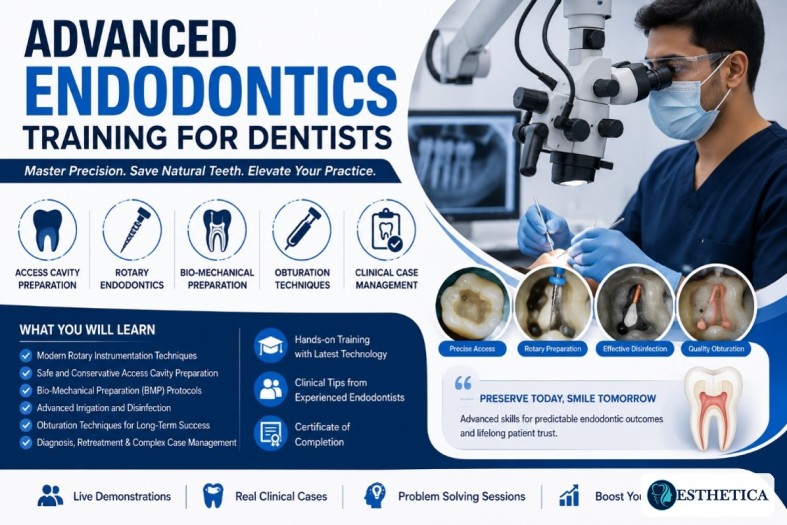
Advanced Endodontics Training for Dentists can provide a broader understanding of contemporary root canal treatment, from diagnosis and access cavity preparation to rotary instrumentation, biomechanical preparation, irrigation, obturation, and complex case management.
For dentists seeking structured clinical education, Esthetica Dental Academy can be considered as a source of advanced dental learning and professional development. The most useful training programs should emphasize sound endodontic principles, practical understanding, case assessment, and safe clinical decision-making rather than focusing only on individual instruments or techniques.
Ultimately, effective endodontic treatment depends on combining knowledge, clinical skills, careful diagnosis, appropriate technology, and professional judgment. Continued education can help dentists strengthen these areas and approach suitable endodontic cases with greater confidence and consistency.
A Message from Dr. Sharad Arya, Founder – Esthetica Dental Academy
When I started Esthetica Dental Clinic in 2012, my vision was simple — to combine clinical excellence with genuine patient care. Over the years, as our practice grew across Punjab, Himachal, and Chandigarh, I realized that the biggest gap in Indian dentistry wasn’t a lack of talent, but a lack of accessible, hands-on implant training for practicing dentists.
That’s why we built Esthetica Dental Academy — not as another certificate mill, but as a mentorship-driven program where dentists actually work on live cases, under supervision, until they’re confident enough to do it on their own. I’ve seen BDS graduates walk in unsure of their surgical skills and walk out ready to plan and execute full-arch implant cases independently.
If you’re serious about growing your implant practice, I’d encourage you to invest in training that prioritizes real clinical exposure over theory alone. That’s the philosophy behind everything we teach here.
— Prof. Dr. Sharad Arya, MDS
Every batch we train is small by design, because implant surgery demands individual attention, not a classroom of fifty watching a screen. Whether it’s digital implant planning, guided surgery, or full-arch rehabilitation, we make sure every participant leaves confident enough to apply it in their own practice.
Frequently Asked Questions
Who Can Join Advanced Endodontics Training?
Dentists who want to improve their understanding and clinical skills in endodontics can benefit from advanced education. The appropriate level of training depends on previous experience and the specific objectives of the program.
What Does Rotary Endodontics Training Cover?
Rotary endodontics training commonly covers file design, glide path preparation, working length, file sequencing, motor settings, speed, torque, instrumentation principles, and safe handling.
What Is BMP in Root Canal Treatment?
Biomechanical preparation, often referred to as BMP, involves cleaning and shaping the root canal system using appropriate mechanical and biological principles while maintaining the anatomy of the canal.
Why Is Access Cavity Preparation Important?
Access cavity preparation provides visibility and instrument access to the canal system. A suitable design should support effective treatment while avoiding unnecessary removal of healthy tooth structure.
Does the Training Include Obturation?
Advanced endodontic programs commonly include obturation principles, materials, techniques, working-length considerations, and radiographic evaluation as part of comprehensive root canal education.
Is Hands-On Practice Included?
The structure varies between training programs. Practical components may include access preparation, rotary instrumentation, working-length determination, irrigation, obturation, and case-based exercises.
Can Complex Cases Be Treated After Training?
Advanced training can improve a dentist’s knowledge and clinical skills, but training does not automatically make every complex case suitable for independent treatment. Dentists should consider their experience, available resources, case complexity, and professional scope before proceeding. Referral may be appropriate when a case exceeds those limits.