







All-on-4 Implant Training in India for UK Dentists: A Complete Guide
Full-arch rehabilitation is one of the most requested treatments in modern implant dentistry, and one of the most demanding to learn. For UK dentists, building these skills often means searching beyond local CPD options. Specialist referral waiting lists are long, patient expectations keep rising, and many courses at home stop at observation or phantom-head work. As a result, a growing number of UK clinicians are exploring All-on-4 implant training in India for UK dentists, where programs built around live patient cases and close mentorship are available.
This guide explains what the All-on-4 concept involves, why India is on the radar for international dentists, what a solid curriculum should cover, and what UK clinicians should check before committing to any course abroad.
What Is the All-on-4 Concept?
All-on-4 is a treatment protocol for rehabilitating a fully edentulous or failing arch with a fixed prosthesis supported by four implants. Instead of placing many implants in areas that may need bone grafting, the clinician places two anterior implants axially and two posterior implants at an angle, commonly between 30 and 45 degrees.
Tilting the posterior implants has two main purposes. First, it makes use of the bone available in the anterior region, which is often denser and more reliable than the posterior maxilla or mandible. Second, it moves the implant platform further back, which allows a longer cantilever-free span and helps avoid anatomical structures such as the maxillary sinus and the inferior alveolar nerve.
The other defining feature is immediate function. When primary stability is adequate, a fixed provisional prosthesis can be delivered on the day of surgery, so the patient leaves with teeth rather than waiting months with a removable denture. That outcome is why patients seek the treatment out, and why dentists who can offer it well tend to see strong demand.
It is not a simple protocol, though. Case selection, surgical planning, torque control, prosthetic design and occlusal management all have to work together. That is why structured, supervised training matters far more here than for single-tooth implants.
Why Some UK Dentists Look to India for Implant Training
There is no single reason UK dentists travel for advanced implant education, but a few themes come up repeatedly.
Live patient exposure. Hands-on experience is the hardest thing to find in advanced implantology. Many courses rely on models, pig jaws or observation. Programs in India that include supervised work on real patients can offer a very different learning experience, because you deal with real anatomy, real bleeding, real stability decisions and real prosthetic problems.
Case volume. Higher patient volumes mean more opportunities to see different bone types, arch shapes and complications in a short period, which can speed up the learning curve.
Cost. Training fees and living costs in India are generally lower than comparable programs in the UK, Europe or North America. Travel is a real cost, so the comparison should include flights, accommodation and time away from your practice.
Language and communication. English is widely used in Indian dental education and clinical settings, so lectures, case discussions and chairside instruction are straightforward for UK clinicians.
Structured pathways. Some academies offer a defined progression from foundation to advanced levels. Esthetica Dental Academy in Mohali, part of the Chandigarh Tricity, runs a dedicated International Dentist Training Program in India alongside its implantology courses, which is relevant if you are planning travel from outside the country.
None of these points guarantee quality on their own. The sections below cover what to look for.
What a Good All-on-4 Curriculum Should Cover
Whatever academy you consider, a credible full-arch course should go well beyond placing four implants. Look for these elements.
Diagnosis and CBCT planning. You should learn to assess bone volume and density, map the nerve and sinus, evaluate the vertical dimension of occlusion, and use planning software to position implants virtually before surgery. Poor planning is the most common cause of avoidable problems in full-arch cases.
Surgical protocol. This includes flap design, flapless versus open approaches, soft tissue management, alveolar bone reduction where needed, and controlled drilling sequences that protect bone from overheating. Trainees should understand how to adapt the sequence to different bone qualities.
Angulation and implant positioning. Tilted posterior implants require precise entry points, correct angulation and appropriate spread between implants. This is the technical core of the concept and deserves dedicated teaching time.
Primary stability and immediate loading. Immediate loading is generally considered safe only when adequate primary stability is achieved. Many protocols cite an insertion torque of around 35 Ncm as a minimum threshold, though clinicians must judge each case individually. A good course teaches how to measure stability, when to load and when to delay.
Multi-unit abutments and prosthetic phase. From multi-unit abutment selection and impression technique to the provisional prosthesis and the final restoration, whether hybrid acrylic or monolithic zirconia, prosthetic planning should be taught as part of the surgical decision, not as an afterthought.
Complication management. Bleeding, soft tissue dehiscence, inadequate stability, screw loosening and prosthetic misfit all occur in real practice. Courses that teach you to anticipate and manage them prepare you far better than those that only demonstrate ideal outcomes.
Esthetica Dental Academy lists a dedicated All-on-4 implant course that focuses on immediate loading concepts and delivering fixed teeth in edentulous patients. Review the course page for current content, format and dates before planning travel.
Inside the Training Experience at Esthetica Dental
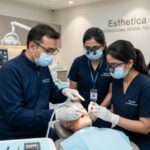
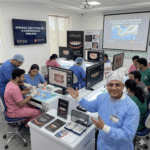
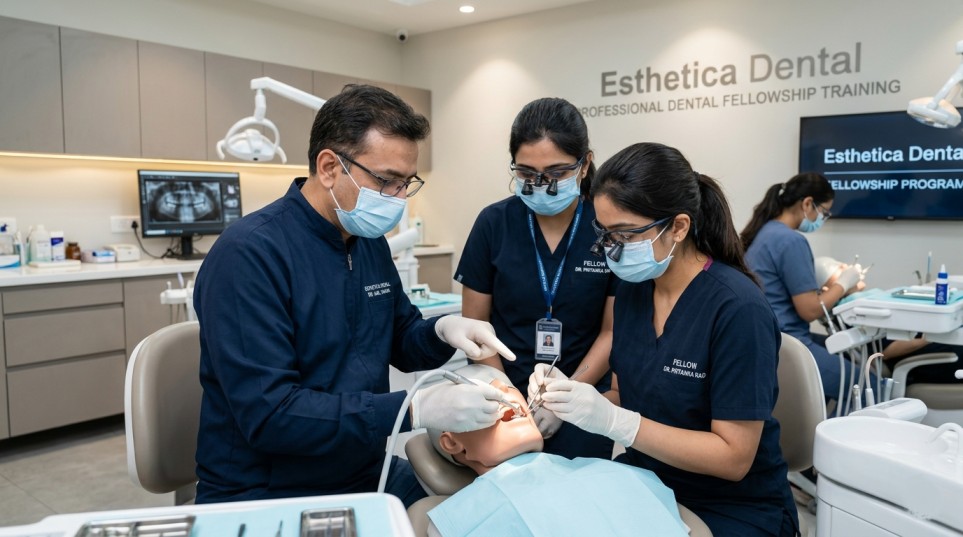
Esthetica Dental Academy is based in Mohali and is led by Prof. Dr. Sharad Arya, a prosthodontist and implantologist with more than 18 years of experience who is described as having trained over 1,000 dentists. The academy’s teaching approach centres on case-based learning, live patient exposure and mentorship from clinicians who practise daily.
For international participants, a typical learning pathway combines theory with clinical immersion: case selection and planning discussions, observation and chairside involvement in live surgeries, and, depending on the program level, supervised hands-on placement. The academy also offers a range of full-arch courses, including All-on-X, All-on-6, tilted implants, zygomatic implants and implant-supported overdentures, so dentists can progress beyond the basics over time.
Because the level of hands-on involvement differs between programs, ask specific questions before enrolling. How many surgeries will you perform yourself, and how many will you only observe? What is the mentor-to-participant ratio? How is patient consent managed? What support is available after you return to the UK?
What UK Dentists Should Check Before Booking
This is the most important section of this guide. Training abroad can be valuable, but it has to fit within UK regulation and professional standards.
GDC standards. In the UK, the General Dental Council expects registrants to work within their scope of practice and competence. Completing a course does not by itself determine what you are allowed to do. You remain responsible for ensuring you are trained, competent and supported to provide any treatment.
Indemnity. Your indemnity provider may have its own expectations about training and experience before you offer advanced implant treatment. Speak to them before you travel, and ask what documentation they would want to see, such as logbooks, supervised case records or mentorship evidence.
Certificate status. Be realistic about what a certificate represents. Esthetica Dental Academy states clearly that its clinical training and mentorship programs are for continuing professional development and skill enhancement. They are not a degree, diploma, residency or statutory qualification recognized by the National Dental Council or any other regulator, and the certificate evidences participation only. Treat it as proof of training undertaken, not as a licence or specialist status.
CPD verification. If you need verifiable CPD hours for your GDC cycle, confirm in advance how hours are recorded and documented.
Ongoing support. Your first independent full-arch cases are the riskiest. Check whether remote case discussion or mentorship is available once you are back home, and consider starting with simpler cases or arranging a local mentor.
Practicalities. Confirm fees, refund terms, accommodation, visa requirements and course dates in writing. Note that this academy’s fee and registration terms state that they are non-refundable.
How Full-Arch Skills Can Affect Your Practice
Offering full-arch treatment can change what your practice is able to provide. Patients with failing dentition, advanced periodontal disease or poorly fitting dentures often want a fixed solution, and many are put off by long referral waits or the cost of travelling to a distant specialist centre.
Dentists who build competence in this area may be able to keep more of these cases in-house, present fixed options more confidently, and communicate the long-term value of treatment more clearly. Patient communication is part of the skill set, because treatment acceptance depends as much on explanation and trust as on surgical ability.
That said, full-arch work carries significant clinical and financial responsibility. Results depend on careful case selection, continued learning and honest assessment of your own limits. A phased approach, with mentoring and gradual increases in case complexity, is usually wiser than rushing into advanced cases.
Frequently Asked Questions
Will an Indian training certificate qualify me to practise All-on-4 in the UK?
No certificate alone does that. Your scope of practice is governed by the GDC and your own competence, and your indemnity provider may set additional expectations. Use the training to build skills and keep thorough records of what you learn and do.
How long does the training take?
Duration depends on the program level and format. Check the relevant course page or contact the academy for current schedules.
Will I work on live patients?
Esthetica Dental Academy states that its training focuses on live patient cases. The extent of your hands-on involvement depends on the program, so confirm exactly what is included before booking.
What qualifications do I need?
You should hold a primary dental qualification and active professional registration. Some experience with basic implant placement or restorative dentistry is advisable before attempting full-arch training.
Is All-on-4 suitable for every patient?
No. Suitability depends on bone quality, systemic health, oral hygiene, occlusion and patient expectations. Good case selection is a core part of any training.
Ready to Take the Next Step?
If you are a UK dentist considering full-arch training, start by comparing programs, asking detailed questions about hands-on involvement, and checking requirements with the GDC and your indemnity provider. If you are still building your implant foundation, the Fellowship in Implantology pathway may be a sensible stepping stone before advanced full-arch courses.
Book a consultation with Esthetica Dental Academy today. Call 9817230279 or email contact@estheticadentalchandigarh.com to discuss which program suits your experience level, travel plans and professional goals.
All-on-4 Implant Training in India for UK Dentists
2-Day
Implantology
An intensive introduction for dentists who want to understand the complete implant workflow.
- ✓2 Days intensive training
- ✓Basic implantology concepts
- ✓Surgical kit demonstration
- ✓Hands-on training
- ✓Live implant surgery exposure
- ✓Certificate
Basic to Advanced
Comprehensive clinical training covering implant placement, bone grafting, sinus lift and prosthetic workflows.
- ✓5–7 Days training
- ✓Live patient surgeries
- ✓Implant placement
- ✓Bone grafting
- ✓Sinus lift
- ✓CBCT planning
- ✓Prosthetic workflow
Implant Diploma
Advanced structured training for dentists seeking deeper implant surgery and prosthetic exposure.
- ✓7 Days intensive program
- ✓15 implant procedures
- ✓Advanced surgery
- ✓Bone management
- ✓Sinus lift
- ✓Prosthetic rehabilitation
- ✓Extended mentorship
Customize Your
Course
Need a program designed around your specific clinical requirements? Build a customized implantology training plan with our team.
- ✓Choose your training duration
- ✓Select specific clinical procedures
- ✓Personalized learning objectives
- ✓Hands-on clinical exposure
- ✓Advanced implantology topics
- ✓Individual mentorship options