









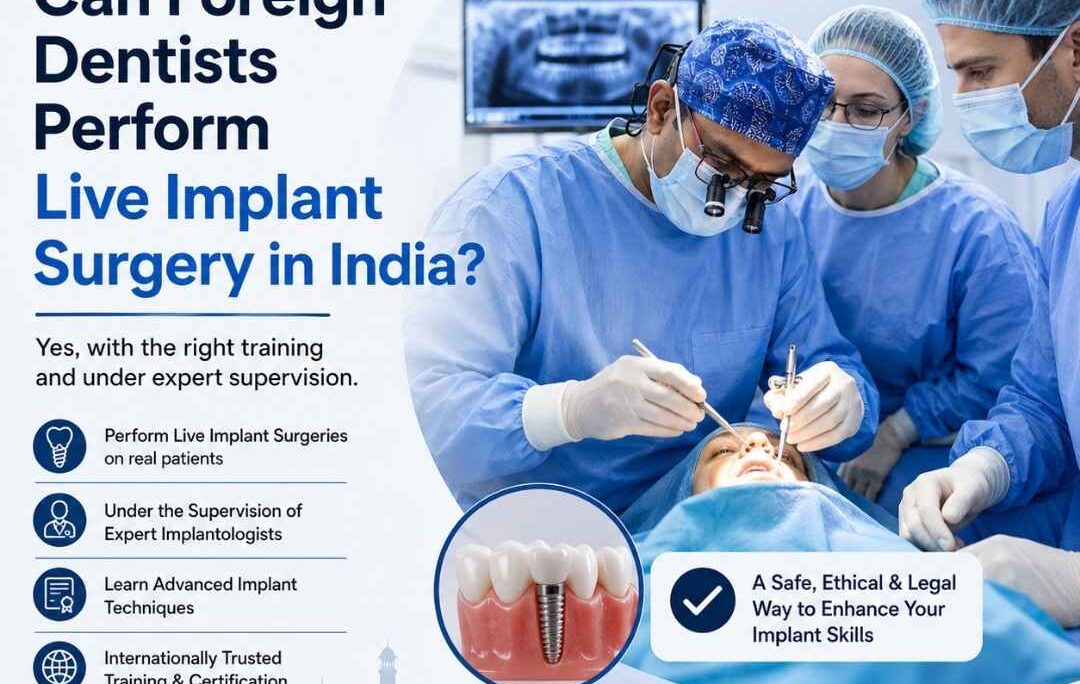
Can Foreign Dentists Perform Live Implant Surgery in India?
If you’re a dentist practicing outside India, chances are you’ve already heard the buzz around foreign dentists live implant surgery in India programs. Every year, hundreds of clinicians fly in from the Gulf, Africa, Southeast Asia, and even North America to sit chairside during real patient cases, not just watch a slideshow. So the question naturally comes up: is this actually allowed, and is it worth the trip? Let’s break it down honestly.
Why India Has Become a Global Hub for Implant Training
India’s dental education system produces some of the most skilled clinicians in the world, but what really draws international dentists here is the sheer patient volume. Clinics in cities like Mohali, Chandigarh, and Delhi treat implant cases daily, which means visiting dentists get to observe techniques on real anatomy instead of plastic models. Add to that the significantly lower cost of advanced training compared to the US, UK, or Australia, and it’s easy to see why India has quietly become one of the top destinations for live implant surgery training India programs.
So, Can Foreign Dentists Perform Live Implant Surgery in India?
Here’s where it gets nuanced. Foreign dentists cannot independently perform surgery on Indian patients as the primary operator unless they hold valid Indian dental registration, because clinical practice in India is regulated by national dental councils. What foreign dentists can do is participate in structured, supervised, hands-on training — observing procedures up close, assisting under the direct guidance of a licensed Indian implantologist, and in many programs, performing supervised steps of the procedure themselves under the mentor’s license and responsibility. This is the model most reputable academies follow, and it’s exactly why dental implant training for foreign dentists is marketed as mentorship-based rather than independent practice.
In short: yes, foreign dentists can be closely involved in live implant surgery in India, but always within a supervised, educational framework rather than as the unsupervised lead surgeon.
What Makes a Genuine Hands-On Implantology Course Different
A lot of courses claim to be “hands-on,” but there’s a real difference between watching a recorded video and standing at the chairside during an actual procedure. A genuine hands-on implantology course India program should include:
- Live case observation with small batch sizes, not a crowded auditorium
- CBCT-guided diagnosis and digital treatment planning sessions
- Direct interaction with the mentoring surgeon before, during, and after the case
- Exposure to different implant systems, bone density situations, and complication management
- Time to ask questions in real time rather than after the fact
If a course can’t offer at least three or four of these, it’s probably closer to a lecture series wearing a hands-on label.
What International Dentists Actually Learn During These Programs
Most visiting dentists arrive already knowing implant theory from their home country curriculum. What they’re missing is exposure to volume — seeing enough varied cases to build real clinical confidence. During a well-structured program, participants typically go through:
Case Selection and Planning — Learning how experienced surgeons decide between immediate loading, delayed loading, or bone grafting based on CBCT scans.
Surgical Technique Refinement — Watching flap design, implant placement angles, and torque management on real patients rather than typodonts.
Prosthetic Integration — Understanding how the surgical and restorative phases connect, since implant success isn’t just about placement, it’s about the final crown fitting properly.
Complication Management — Perhaps the most valuable part, since textbooks rarely prepare clinicians for what to do when something doesn’t go as planned.
Eligibility and Requirements for Foreign Dentists
Most academies require participants to hold a valid dental degree (BDS, DDS, or equivalent) from a recognized institution in their home country, along with proof of active clinical practice. A basic understanding of implant fundamentals is usually expected before enrolling in an advanced hands-on batch, though foundation-level courses are often available for dentists newer to implantology. Visa requirements are typically handled under a medical training or business visa category, and most academies assist with invitation letters to simplify the process.
Why Canadian and Other International Dentists Are Choosing India
Interestingly, a growing number of enquiries for live implant surgery training India programs now come from Canada. Canadian dentists often cite long waitlists for hands-on CE courses back home, along with tuition costs that can run several times higher than equivalent programs in India. For a Canadian dentist looking to add full-arch implant skills or All-on-6 protocols to their practice, a two-to-three week intensive in India often delivers more live case exposure than an entire year of weekend courses locally.
Choosing the Right Academy for Your Training Journey
Not every academy delivers what it promises, so it’s worth checking a few things before booking: how many live cases you’ll actually observe or assist with, the mentor’s real surgical experience (not just certificates on a wall), batch size, and whether post-course mentorship is offered once you’re back home treating your own patients. Programs at Esthetica Advanced Dental Academy are built around small batch sizes and direct mentorship with practicing implant surgeons, which is the model most clinicians say matters more than any brochure.
Final Thoughts
Live implant surgery training in India has genuinely reshaped how international dentists build confidence in implantology, offering volume, affordability, and mentorship that’s hard to match elsewhere. If you’re considering this path, prioritize supervised, structured programs over anything promising unrestricted “solo surgery” access, since that framing usually signals a course that isn’t following proper clinical protocols.
A Message from Dr. Sharad Arya, Founder – Esthetica Dental Academy
When I started Esthetica Dental Clinic in 2012, my vision was simple — to combine clinical excellence with genuine patient care. Over the years, as our practice grew across Punjab, Himachal, and Chandigarh, I realized that the biggest gap in Indian dentistry wasn’t a lack of talent, but a lack of accessible, hands-on implant training for practicing dentists.
That’s why we built Esthetica Dental Academy — not as another certificate mill, but as a mentorship-driven program where dentists actually work on live cases, under supervision, until they’re confident enough to do it on their own. I’ve seen BDS graduates walk in unsure of their surgical skills and walk out ready to plan and execute full-arch implant cases independently.
If you’re serious about growing your implant practice, I’d encourage you to invest in training that prioritizes real clinical exposure over theory alone. That’s the philosophy behind everything we teach here.
— Prof. Dr. Sharad Arya, MDS
Every batch we train is small by design, because implant surgery demands individual attention, not a classroom of fifty watching a screen. Whether it’s digital implant planning, guided surgery, or full-arch rehabilitation, we make sure every participant leaves confident enough to apply it in their own practice.
Frequently Asked Questions
1. Can a foreign dentist legally perform implant surgery in India?
Foreign dentists can participate in supervised, hands-on implant training in India, working alongside a licensed Indian implantologist. Independent, unsupervised practice requires local dental registration.
2. How long does a typical live implant training program last in India?
Most hands-on implantology courses run anywhere from a few days to three weeks, depending on whether it’s a foundation course or an advanced full-arch rehabilitation program.
3. Do I need a special visa to attend dental training in India?
Most participants apply under a medical training, conference, or business visa category. Reputable academies usually assist with the required invitation documentation.
4. Is dental implant training in India recognized internationally?
These programs are typically certificate-based continuing education rather than statutory degrees, so recognition depends on your home country’s CE and licensing requirements. It’s worth checking with your local dental board.
5. Why are so many Canadian dentists choosing implant training in India?
Long CE waitlists and high costs in Canada have pushed many dentists to look abroad. India offers significantly more live case exposure at a fraction of the cost.
6. What’s the difference between observation-only courses and hands-on courses?
Observation-only courses let you watch procedures from a distance, while hands-on courses involve direct chairside participation and, in many cases, supervised assisting during the actual surgery.
7. What should I check before enrolling in an implant training academy in India?
Look at batch size, the mentor’s actual surgical caseload, whether CBCT-guided planning is included, and whether post-training mentorship support is offered once you return home.