








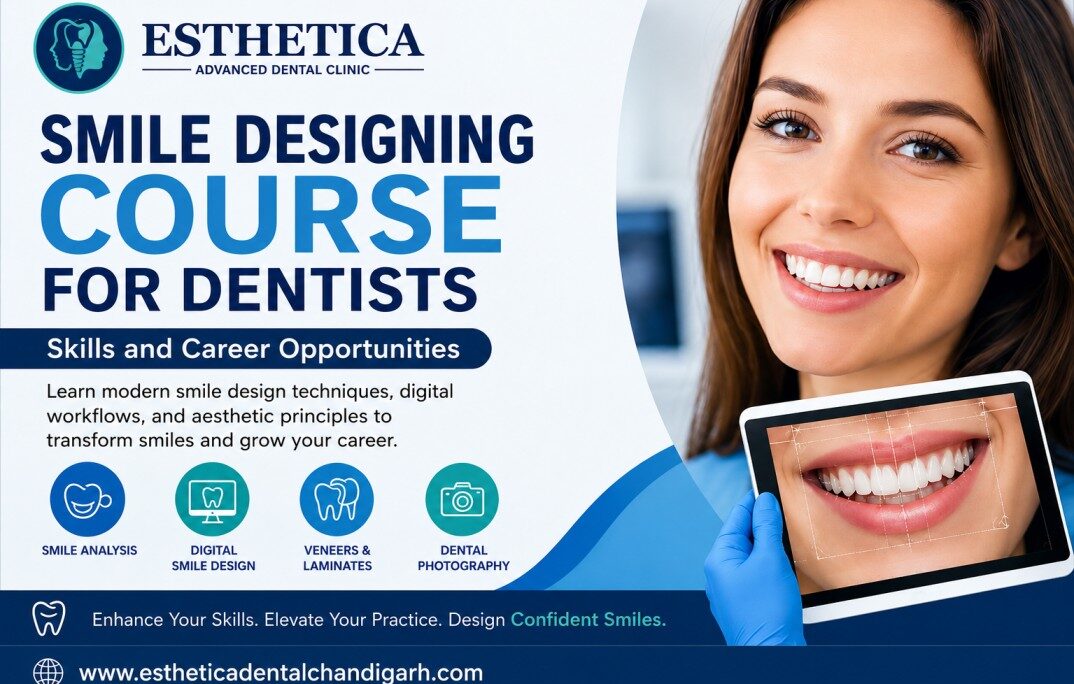
Smile Designing Course for Dentists Skills and Career Opportunities
A beautiful smile is no longer purely cosmetic. Patients increasingly want smiles that look natural, balanced, healthy, and suited to their facial appearance. Meeting these expectations requires more than clinical knowledge. A Smile Designing Course for Dentists can help clinicians develop skills in smile analysis, treatment planning, digital technology, photography, veneers, laminates, and cosmetic procedures while creating opportunities for professional growth.
Why Are Dentists Choosing Smile Designing Training?
Patients Want Natural-Looking Smile Transformations
Modern patients are better informed about cosmetic dentistry. They may visit a clinic with questions about veneers, whitening, bonding, digital smile design, or other treatments. They want attractive results that look natural rather than artificial.
Smile designing combines dental science with facial appearance, tooth proportions, lip movement, gum display, colour, shape, and harmony. Dentists can learn to create individualised plans rather than use one standard approach.
Key Skills Covered in Smile Designing Courses
Learn Smile Analysis and Treatment Planning
Smile analysis is a central part of cosmetic dentistry. Dentists need to understand the existing smile before planning a transformation. Training may cover facial proportions, dental midline, tooth size, gingival display, smile arc, symmetry, and tooth-to-tooth relationships.
This knowledge supports balanced treatment planning. Rather than following a fixed formula, dentists can assess each patient and decide which changes are appropriate. Planning also connects aesthetic goals with function and restorative needs.
Develop Clinical Photography Skills
Clinical photography supports diagnosis, treatment planning, documentation, laboratory communication, and patient education. Learning to capture clear facial and intraoral images can help dentists study the smile and communicate treatment ideas effectively.
Digital Smile Design Is Transforming Cosmetic Dentistry
Visualise the Proposed Smile
Digital Smile Design uses photographs and planning tools to present possible smile changes. Visual information can make treatment discussions easier, encourage shared decision-making, and support an organised workflow from diagnosis through restoration.
Technology Must Support Clinical Knowledge
Software alone cannot create a successful smile. Dentists still need knowledge of diagnosis, treatment planning, preparation, restorative principles, occlusion, and laboratory communication. A useful Digital Smile Design Course should explain how technology supports clinical decisions and its limitations.
Cosmetic Dentistry Skills Dentists Can Develop
Veneers and Laminates
Veneers and laminates are commonly used for smile enhancement. Dentists need to understand indications, preparation, materials, shade selection, impressions or digital scans, temporisation, and cementation.
Training should also help clinicians recognise situations where these treatments may not be appropriate. Alternatives should be considered when they offer a more suitable solution. The objective is to achieve attractive results while respecting tooth structure, function, longevity, and patient expectations.
Understand Tooth Proportions and Shade
Small changes in tooth length, width, contour, and anatomy can influence smile aesthetics, especially when several anterior teeth are restored. Shade selection should also consider facial appearance, neighbouring teeth, restorative materials, and patient expectations rather than simply choosing the whitest shade.
Why Hands-On Smile Designing Training Matters
Turn Theory Into Practical Skills
Lectures and textbooks provide useful foundations, but practical learning can help dentists apply concepts to realistic situations. Smile Designing Training may involve photograph evaluation, case presentations, digital planning, treatment discussions, and practical exercises.
Hands-on learning allows dentists to move beyond memorising techniques. They can consider different treatment options and understand how clinical findings influence decisions. Exposure to varied cases can also prepare clinicians for situations that do not match ideal textbook examples.
Learn Through Case-Based Discussion
Case-based learning is valuable because smile design is individual. Reviewing a case from initial concern through analysis, planning, restoration, laboratory communication, and maintenance helps dentists understand how age, facial appearance, periodontal health, occlusion, and expectations can change treatment.
How Smile Designing Training Can Support Your Career
Expand Cosmetic Dentistry Services
Dentists who develop smile design skills can incorporate a wider range of aesthetic services into suitable cases. Smile analysis can complement restorative dentistry, prosthodontics, orthodontic considerations, whitening, veneers, bonding, and other cosmetic procedures.
This broader knowledge can help dentists create comprehensive treatment plans and discuss appropriate options with patients. Continued education remains important because cosmetic materials, digital workflows, photography, and planning concepts continue to evolve.
Improve Patient Communication
Patients often have questions about cost, longevity, appearance, and expected results. Dentists with smile design knowledge can explain treatment choices clearly.
Photography and digital previews can make discussions easier to understand. Clear communication also helps establish realistic expectations and supports shared decision-making.
Employment Prospects After Smile Designing Training
Develop an Aesthetic Dentistry Focus
Dentists can develop a stronger professional focus on aesthetic and cosmetic dentistry by incorporating smile analysis and treatment planning into suitable cases. Continued education remains important because aesthetic dentistry continues to evolve.
Strengthen Dental Laboratory Collaboration
Smile design often requires close cooperation with dental laboratories. Veneers, crowns, laminates, and anterior restorations require clear communication about shape, colour, proportions, function, and aesthetic goals. Smile design knowledge can make this collaboration more effective.
Explore International Dentistry Opportunities
Aesthetic dentistry has global relevance, including among patients in Canada. Continuing education can strengthen knowledge of contemporary workflows and digital planning. Dentists must still meet the relevant licensing and registration requirements before practising overseas.
What Should Dentists Look for in a Smile Designing Course?
Choose More Than Software Training
Dentists should review the full syllabus for smile analysis, photography, treatment planning, veneers, laminates, restorative principles, digital planning, case selection, communication, and practical learning. Faculty experience and real case teaching are also valuable.
Look for Practical and Case-Based Learning
A strong course should encourage questions, discussion, and practical application. Dentists should examine varied cases and learn how treatment can be individualised. The goal is clinical judgement: understanding why a treatment is selected, not only how it is performed.
Why Choose Esthetica Dental Academy?
Esthetica Dental Academy provides smile designing education focused on contemporary aesthetic dentistry. The training introduces dentists to smile analysis, digital planning, photography, veneers, laminates, and other important aspects of smile design.
The objective is to help delegates understand how smile design components connect within a treatment workflow and support continued development.
A Message from Dr. Sharad Arya, Founder – Esthetica Dental Academy
When I started Esthetica Dental Clinic in 2012, my vision was simple — to combine clinical excellence with genuine patient care. Over the years, as our practice grew across Punjab, Himachal, and Chandigarh, I realized that the biggest gap in Indian dentistry wasn’t a lack of talent, but a lack of accessible, hands-on implant training for practicing dentists.
That’s why we built Esthetica Dental Academy — not as another certificate mill, but as a mentorship-driven program where dentists actually work on live cases, under supervision, until they’re confident enough to do it on their own. I’ve seen BDS graduates walk in unsure of their surgical skills and walk out ready to plan and execute full-arch implant cases independently.
If you’re serious about growing your implant practice, I’d encourage you to invest in training that prioritizes real clinical exposure over theory alone. That’s the philosophy behind everything we teach here.
— Prof. Dr. Sharad Arya, MDS
Every batch we train is small by design, because implant surgery demands individual attention, not a classroom of fifty watching a screen. Whether it’s digital implant planning, guided surgery, or full-arch rehabilitation, we make sure every participant leaves confident enough to apply it in their own practice.
Frequently Asked Questions
1. What is a Smile Designing Course for Dentists?
It teaches smile analysis, aesthetic planning, digital technology, photography, veneers, laminates, and cosmetic dentistry.
2. Who can join a smile designing course?
Dentists seeking stronger cosmetic dentistry and smile analysis skills can consider suitable programs.
3. Is digital smile design important?
Yes. It can support case analysis, visual communication, treatment presentation, and laboratory communication.
4. Does smile designing training include practical learning?
Course structures vary, but practical exercises and case analysis can improve clinical learning.
5. Can smile design improve patient communication?
Yes. Photography and digital planning can make treatment explanations clearer.
6. Can dentists from Canada take smile designing training?
Dentists from Canada may pursue continuing education subject to course eligibility and professional requirements.
7. Does smile designing training offer career opportunities?
It can expand cosmetic dentistry knowledge, treatment planning, laboratory communication, and aesthetic dentistry skills.
Take the Next Step in Smile Design
A confident, natural-looking smile can influence how patients feel and communicate. For dentists, creating aesthetic results requires clinical knowledge, visual judgement, communication, and careful treatment planning. Smile Designing Course for Dentists can provide a structured way to develop these skills while introducing clinicians to modern digital workflows and cosmetic dentistry concepts.
The most valuable courses explain the reasons behind treatment decisions rather than isolated techniques. Dentists can learn how smile analysis, photography, digital planning, restorative procedures, and patient expectations work together.
Ongoing education helps dentists respond to changing patient expectations and advances in dental technology while preparing for opportunities in aesthetic dentistry.