








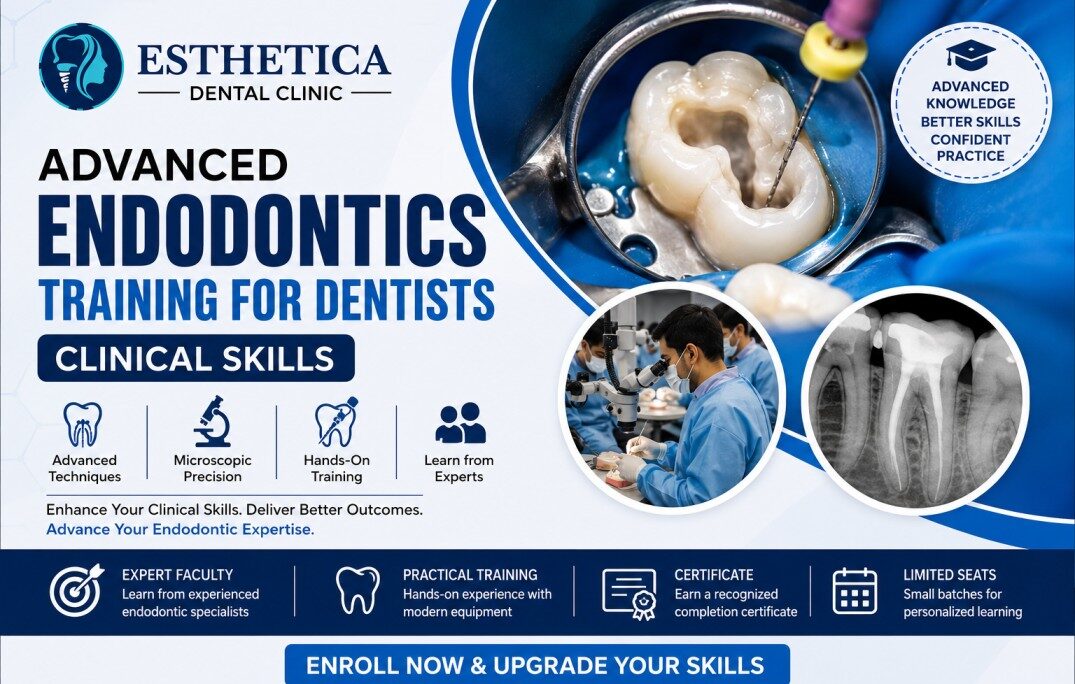
Advanced Endodontics Training for Dentists
Root canal treatment has seen a number of innovations in modern instrumentation, irrigation, and obturation. However, for those who are able to go beyond foundational endodontic training, advanced endodontics instruction enables one to develop systematic skills in addressing cases from a broader perspective. Advanced Endodontics Training for Dentists is a program that covers rotary endodontics, access cavity, biomechanical preparation (BMP), obturation, diagnosis, and clinical management of cases. Advanced Endodontics Training for Dentists seeks to enable participants to be better prepared when managing endodontic cases, from initial diagnosis, through the procedure, and to the management of outcomes, while being aware of the limits of their expertise and scope of practice.
Why Advanced Endodontics Training Matters
Endodontic cases are usually straightforward, but they can become very complicated throughout the process. With various challenges such as curved canals, calcification, challenging anatomy, poor visualization, and treatment interference, dentists must be prepared when managing such cases.
Start With a Precise Access Cavity
Access cavities provide the pathway to the canal system, and a good access cavity should ensure proper visualization while avoiding the unnecessary removal of tooth structure. Through advanced endodontic training, dentists can learn how to prepare an access cavity, including identifying the canal orifices, managing challenges such as calcified pulp chambers, and modifying access design, among others.
Master Rotary Endodontics With Confidence
Nickel-titanium rotary instruments have become a significant part of contemporary endodontics. Nevertheless, their effective use requires some basic knowledge and caution when preparing the canal. Through advanced endodontic training, dentists can learn such concepts as file design, sequence, glide path, working length, speed, torque, irrigation, and handling. Moreover, a good training program will also acquaint participants with the proper use of nickel-titanium rotary instruments as well as the conditions under which such instruments can fail, such as improper torque or apical instrumentation.
Understand Biomechanical Preparation
Biomechanical preparation goes beyond simply enlarging the canal. Through advanced endodontic training, dentists can become familiar with such aspects of canal preparation as working length and glide path, canal instrumentation, apical control, taper, and biomechanics, as well as other related concepts.
Improve Irrigation and Canal Disinfection
With the complexity of root canal systems, mechanical instrumentation alone cannot adequately clean the canal. Thus, irrigation plays a critical role in removing cellular debris during mechanical preparation. Advanced endodontic training often covers such aspects of irrigation as principles, solutions, activation, and safety. Moreover, this step also acquaints participants with the concepts of irrigation, including the rationale behind proper irrigation and the mechanisms involved.
Achieve Better Results With Proper Obturation
The obturation process is the final step in the root canal procedure, and it involves filling the cleaned and prepared canal by means of adequate filling materials. Advanced endodontic training can help participants to learn such aspects of obturation as master cone selection, sealer, condensation, heat, working length, and radiographic evaluation. In addition, dentists can also learn the relative advantages and disadvantages of different obturation techniques, as well as the practical aspects of each method. It is important to note that obturation can only be effective if the preparation and irrigation steps have been properly done.
Strengthen Diagnosis Before Treatment
A good diagnosis often determines the overall success of an endodontic procedure. Mechanical pain, for example, is not necessarily an indication of a need for root canal treatment, but rather, it may be associated with a wide range of other factors. Advanced endodontic training helps participants to become more skilled in diagnosis through medical and dental history, percussion or palpation, sensibility tests, periodontal condition, radiographic examination, and other examinations or tests. Such an approach helps participants understand the underlying etiology of the problem while also helping to rule out other relevant concerns.
Learn to Manage Challenging Clinical Cases
Most real-world cases are rarely ideal, and as such, it is important for dentists to be familiar with the management of such scenarios. For instance, dentists are likely to encounter such scenarios as calcified canals, challenging anatomy, highly curved canals, re-treatment of root canals, instrument separation, ledges, and questionable management and diagnosis. Advanced endodontic training helps participants to gain skills in clinical case management, which involves reviewing particular cases and considering possible options and treatments in managing the case
Build a Safer, More Predictable Workflow
Advanced endodontic training enables the development of safe and predictable protocols for root canal treatment. A root canal procedure typically follows a particular sequence, starting with diagnosis and treatment planning. Following that, the dentist may proceed to isolation, access cavity preparation, canal scouting, determination of working length, and biomechanical preparation. The dentist will then carry out irrigation, obturation, and restoration, according to established guidelines and techniques. Thus, it is important to have such a systematic approach to carrying out a root canal procedure.
Moreover, this knowledge helps the dentist to understand all aspects of the procedure, which also helps the dentist avoid mistakes or oversight. It is also helpful for a dentist to remember that root canal treatment is beyond just a few procedures. Rather, it is a combination of various steps, and hence, it is important to consider and follow them all. Nevertheless, dentists must not forget their scope of practice when making clinical decisions or managing cases at Esthetica Dental Academy.
Take Your Endodontic Skills to the Next Level
Advanced Endodontics Training for Dentists is ideal for dentists who are looking to develop a comprehensive and systematic understanding of contemporary endodontic treatment. Through such training, dentists can gain new insights on managing endodontic cases using rotary endodontics, access cavity, BMP, irrigation, obturation, diagnosis, and management of challenging cases. The best endodontic training program should therefore focus more on developing basic principles and practical aspects of endodontic treatment.
Frequently Asked Questions
1. Who can join advanced endodontics training?
Anyone who wants to improve their endodontic skills can benefit from advanced endodontic education.
2. What does rotary endodontics training cover?
Such a program will typically cover the principles of file design, working length, glide path, sequence, speed, torque, and safe handling.
3. What is BMP in root canal treatment?
Biomechanical preparation (BMP) entails canal preparation and the application of other principles that facilitate the cleaning of the root canal system.
4. Why is access cavity preparation important?
A proper access cavity provides good visibility and support when working on the canal system while also minimizing the amount of tooth structure that needs to be removed. Thus, it is important to prepare a conservative access cavity.
5. Does the training include obturation?
Yes, because it is an essential component of a root canal procedure. One can therefore expect to learn about obturation, including technique, materials, and radiographic assessment.
6. Is hands-on practice included?
Yes, since most root canal procedures involve such practical aspects as access preparation, rotary instrumentation, working length determination, irrigation, obturation, and other related procedures.
7. Can complex cases be treated after training?
Advanced endodontic training will certainly help, but it is important to remember that the limitations of scope and experience should always be considered, especially when dealing with a complex case.