







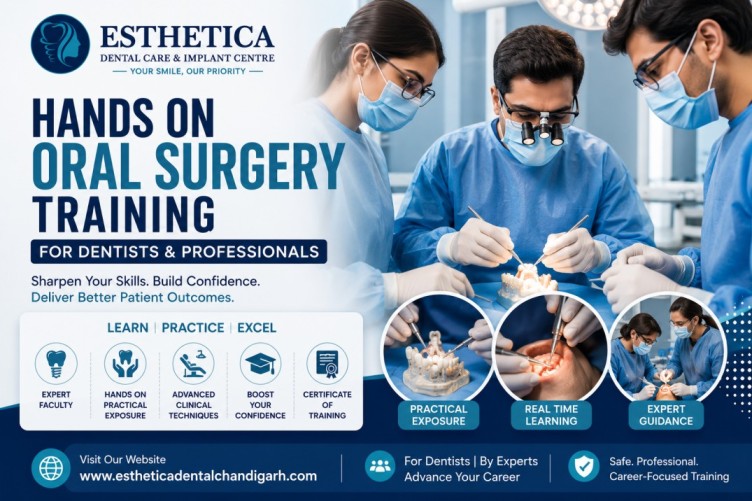
Hands On Oral Surgery Training for Dentists and Professionals
Oral surgery is more than just theoretical knowledge – it involves manual skills, clinical decision-making, case selection and management, and confidence in the execution of a variety of surgical procedures. Hands-On Oral Surgery Training for Dentists offers the opportunity to acquire, practice, and perfect these skills through demonstrations, lectures, hands-on participation, and discussion. It gives dental practitioners a real opportunity to expand their surgical expertise and update their clinical know-how beyond the theoretical knowledge found in textbooks and gain an opportunity for direct mentorship and guidance. Hands-on training will enable them to better understand the nuances of various surgical procedures and how theoretical knowledge applies directly to surgical decision-making and actions taken during the operation.
An effective oral surgery training course will provide students with a fundamental knowledge of surgical extractions, local anesthesia administration, principles of flap design and incision, suturing principles and techniques, and the management of surgical sites during and following a procedure. All these elements are essential components of any surgical intervention. Therefore, a proper understanding of techniques used during various stages of the surgery is vital for a dentist to ensure the best outcome of the procedure. Moreover, such training enables participants to gain necessary skills and practical expertise through observing how instruments are being used correctly and developing their manual skills. In addition, they can ask questions and discuss the intricacies of the procedures with the mentors to gain insight into their expertise and experience.
Why Hands-On Oral Surgery Education Is Important Essay
While many dentists are well-versed in the theoretical aspect of oral surgery, some might encounter difficulties performing particularly challenging procedures. Such situations call for hands-on training, which allows future surgeons to observe, practice, and ask questions. This type of training ensures the practitioners will have an adequate understanding of the necessary techniques and be knowledgeable about potential pitfalls.
Surgical extraction is one of the core concepts of the course, which covers treatment planning and controlled clinical skills. The participants learn to identify complex situations, analyze the tooth or root morphology and plan the most appropriate surgical intervention. In parallel, the emphasis is placed on proper surgical instrumentation and tissue manipulation in order to prevent traumatizing the tissues. By learning the principles of surgical extraction, dentists gain the capacity to intervene in a particular clinical setting with a series of well-considered steps. Moreover, this element of the course also promotes their capacity to recognize when a particular procedure is beyond their skills and requires referral to a maxillofacial surgeon.
Local Anesthesia
Local anesthesia is an integral element of any oral surgical intervention as it ensures comfort and safety of the patient throughout the procedure. The course covers the critical principles of local anesthesia and teaches the participants to master various techniques, which are aimed at ensuring comfort and successful intervention. The trainees learn to identify the relevant anatomical landmarks with high precision, receive the know-how of proper injection techniques, and gain the competence to determine the most suitable dosage for the patient. At the same time, the candidates learn to evaluate whether the success of the technique has been achieved prior to proceeding to surgery. Through this element of the course, the dentists obtain the capacity to engage patients in communication in order to minimize their level of distress, fear, and anxiety associated with the procedure.
Flap Design
Flap design is a critical procedure of any oral surgical intervention, which makes it an important element of the program. The trainees are provided with the knowledge of basic principles of flap design, including incisions, reflection of flap tissues, retraction, and access to the target tissue. In addition, they are able to review the principles of flap design during the practical sessions and master the necessary clinical skills to intervene in a wide range of indications. Furthermore, the course teaches the participants to consider multiple clinical factors, which need to be taken into account in each individual case, including the location of the flap, associated anatomical structures, planned intervention, and closure technique. Such an approach ensures that the dentist gains the ability to avoid unnecessary trauma to soft tissues and perform the intervention efficiently.
Suturing Techniques
Suturing is one of the critical skills required for oral surgical interventions, which is why the course is designed to provide the trainees with the opportunity to master this procedure. The participants learn the techniques of proper surgical instrumentation, including holding, cutting, and suturing as well as the principles of knot-tying. The practical skills obtained from this element of the course enable the participants to achieve efficient tissue closure and facilitate the post-surgical healing process. In addition, the trainees obtain the critical understanding of how the proper suturing supports the physiological function of the tissue after the procedure. By practicing various techniques of tissue approximation and closure, the dentists gain the opportunity to develop the necessary hand-eye coordination and perform more precise tissue interventions.
Hands On Oral Surgery Training for Dentists
Hands on oral surgery training helps dentists build practical confidence in performing essential surgical procedures in a supervised clinical environment. At Esthetica Dental Academy dentists can strengthen their understanding of treatment planning, surgical techniques, patient management, and post operative care through practical learning. This type of training is designed to bridge the gap between theoretical knowledge and real clinical practice, helping dental professionals improve their skills and deliver more predictable treatment outcomes.
Frequently Asked Questions
1. What is Hands-On Oral Surgery Training for Dentists?
This is a practical training course that focuses on the development of practical skills through demonstration, guided practice, discussion, and feedback.
2. Who will benefit from oral surgery training courses?
Dentists who want to develop their practical skills to gain confidence in performing a range of surgical interventions.
3. Can I learn surgical extraction during the course?
This procedure is included in the training curriculum as an essential component of oral surgery.
4. Why is flap design so important in oral surgery?
Flap design is vital because it directly affects the outcome of the procedure, the preservation of healthy tissues, and post-operative discomfort.
5. Will I be able to learn suturing methods during the practical training?
During the course, you will be able to practice various suturing techniques, master the necessary motor skills, and become familiar with the principles of closing wounds.
6. Are complications considered during oral surgery training?
The course covers the main areas of oral surgery, including strategies for managing and preventing complications.
7. What benefits does hands-on training provide?
Supervised practice allows the dentist to consolidate theoretical knowledge, acquire new practical skills, and gain confidence and control in managing different surgical interventions.