








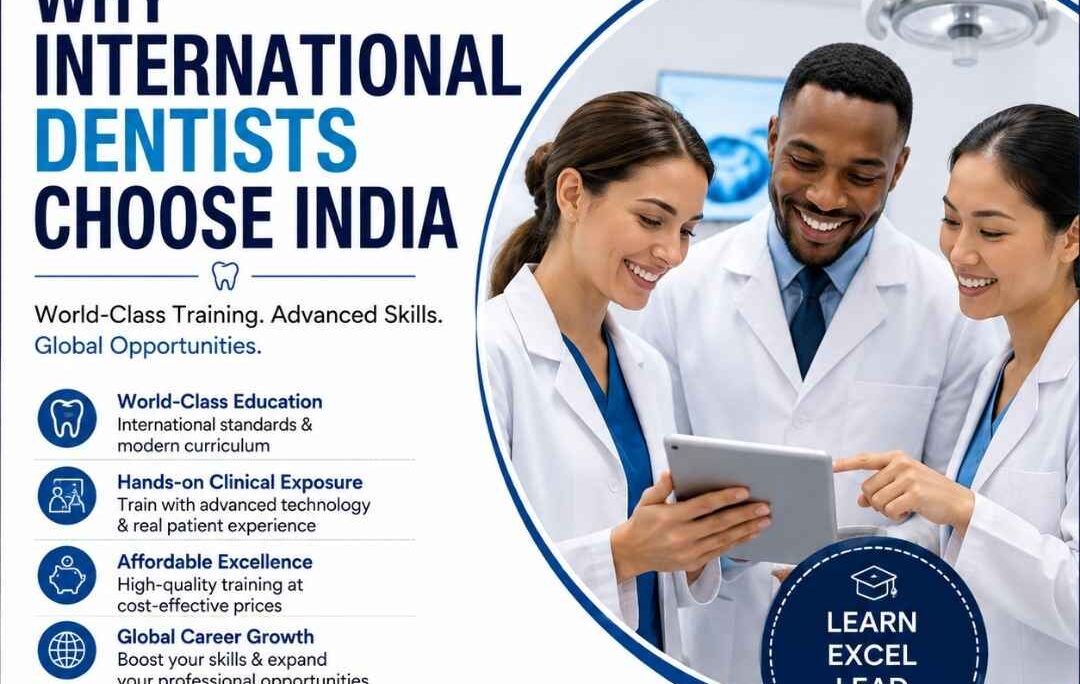
Why International Dentists Choose India
Choosing where to continue dental education is an important decision for any international dentist. Why International Dentists Choose India is becoming a valuable search topic because dentists from Canada and other countries are exploring opportunities to learn new techniques, observe different clinical workflows, and gain professional exposure in a diverse healthcare environment. India offers a broad range of dental specialties, experienced professionals, modern clinical technology, and learning opportunities that can complement an international dentist’s existing knowledge.
For Canadian dentists, international training can also provide a fresh perspective on treatment planning and patient care. Instead of replacing existing professional knowledge, a well-structured programme can help dentists compare approaches, discuss challenging cases, and explore developments in areas such as implant dentistry, cosmetic dentistry, restorative care, prosthodontics, and digital dentistry.
Why International Dentists Choose India for Dental Education
India has a large and diverse dental healthcare ecosystem, which makes it an interesting destination for professional learning. International dentists may find opportunities to explore multiple areas of dentistry within a single training environment.
One of the major advantages is clinical diversity. Dentists can encounter different patient expectations, oral health conditions, treatment requirements, and case complexities. Reviewing such cases can encourage broader clinical thinking and more detailed treatment planning.
India also has a growing focus on modern dental technology. Depending on the training provider, dentists may be introduced to digital imaging, CAD/CAM workflows, implant planning, aesthetic dentistry, restorative procedures, and other technology-supported approaches.
Learning Beyond the Textbook
Professional dental training is often more valuable when theoretical concepts are connected to real clinical situations. Case discussions, demonstrations, treatment planning sessions, and supervised educational activities can help international dentists understand how clinical decisions are made.
The exact activities available depend on the programme and applicable regulations. Foreign dentists should always confirm whether a course is observational, workshop-based, or includes any form of supervised clinical participation before enrolling.
Diverse Clinical Exposure Can Strengthen Professional Knowledge
One reason international professionals consider India is the opportunity to observe a wide variety of dental cases. A diverse clinical environment can expose dentists to different treatment priorities and patient expectations.
For example, a dentist interested in implant dentistry may want to study how clinicians assess bone quality, evaluate implant candidates, plan treatment, and manage restorative stages. Someone interested in aesthetic dentistry may instead focus on smile design, veneers, tooth proportions, and digital planning.
This type of exposure can be especially useful for experienced dentists who already understand the fundamentals but want to compare different clinical approaches.
Case-Based Learning for International Dentists
Case-based education encourages dentists to look beyond individual procedures. A useful discussion may involve diagnosis, treatment alternatives, sequencing, materials, patient communication, expected outcomes, and long-term maintenance.
For a Canadian dentist, comparing these approaches with familiar workflows at home can create useful professional insights. The goal is not necessarily to copy another system but to understand why different clinicians make particular decisions.
Modern Dental Technology and Training Opportunities
Technology has changed how dental professionals diagnose, plan, and deliver treatment. International dentists may be interested in learning how digital tools are incorporated into everyday clinical workflows.
Depending on the programme, training may cover digital X-rays, 3D imaging, digital smile design, CAD/CAM dentistry, intraoral scanning, digital implant planning, and computer-assisted treatment workflows.
Technology should not be viewed as a replacement for clinical judgment. Instead, it can support diagnosis, communication, treatment planning, and precision when used appropriately.
Dental Implant Training and Advanced Clinical Learning
Dental implants are among the areas that attract professional interest from dentists seeking advanced education. Training may include patient assessment, treatment planning, implant positioning concepts, restorative considerations, maintenance, and case discussions.
International dentists should carefully review what a particular dental implant training programme actually includes. A short educational course may focus on theory and observation, while a longer programme may provide a different level of professional exposure.
Always confirm trainer credentials, course objectives, clinical permissions, and certification before making arrangements.
Why Mohali Is Attracting Attention From International Dentists
Mohali, part of the Chandigarh Tricity region, has developed into a growing centre for healthcare, education, and professional services. This makes the area relevant to dentists searching for focused educational and clinical learning opportunities.
International professionals may also find the region convenient because it combines access to healthcare facilities with educational infrastructure and connectivity to Chandigarh.
For those searching for Esthetica best dental clinic and training in Mohali, it is important to evaluate the actual training experience rather than relying only on marketing language. Course structure, trainer qualifications, clinical facilities, learning objectives, and professional support should all be considered.
How to Choose a Top Dental Clinic in Mohali
Searching for a top dental clinic in Mohali is only the beginning. International dentists should investigate whether a clinic or training provider is appropriate for professional education and whether its programmes match their specific goals.
Look at the experience and qualifications of the trainers, the clinical technology available, the range of dental procedures offered, and the type of cases used for learning.
It is also important to ask whether the training is designed for qualified international dentists. Advanced professionals may require a different educational approach from dental students or beginners.
What Should You Ask Before Enrolling?
Before booking a programme, ask for clear information about the duration, daily schedule, course content, trainer profile, learning activities, certification, fees, and cancellation policy.
Foreign dentists should also ask whether they are allowed to observe, participate in demonstrations, attend workshops, or take part in any clinical activities. Professional qualifications from another country do not automatically mean that a dentist can practise independently in India.
Getting these details in writing can make the planning process much easier.
Finding Top Dental Training in Mohali
Dentists searching for top dental training in Mohali should compare programmes according to educational quality rather than simply choosing the cheapest or shortest course.
A good programme should have clear learning objectives. Participants should understand what they will study, how the material will be delivered, and what they can reasonably expect to learn by the end.
Training may focus on specific subjects such as implants, restorative dentistry, prosthodontics, cosmetic dentistry, digital workflows, smile design, or comprehensive treatment planning.
The Importance of an Experienced Trainer
A strong trainer can make a major difference to the learning experience. Instead of simply demonstrating a procedure, an experienced educator can explain the reasoning behind diagnosis, treatment selection, sequencing, and patient management.
International dentists may also benefit from asking questions based on cases from their own practices. Comparing different treatment philosophies can make the training more interactive and professionally relevant.
Those specifically searching for a foreign dentist trainer in Mohali should verify the trainer’s qualifications, clinical experience, teaching background, and experience working with international professionals.
Cosmetic and Aesthetic Dentistry as a Growing Learning Area
Cosmetic dentistry is another area that attracts international dental professionals. Patients increasingly seek treatments that improve both oral function and smile appearance.
Training in this field may cover smile analysis, tooth proportions, veneers, restorative materials, digital smile concepts, colour selection, and treatment planning.
For dentists from Canada, exposure to different aesthetic workflows can provide additional ideas for patient communication and treatment presentation. However, techniques should always be evaluated according to evidence, professional standards, and individual patient needs.
Digital Dentistry and the Future of Clinical Practice
Digital dentistry continues to influence modern dental workflows. Scanning, imaging, digital planning, and computer-aided manufacturing can improve communication between dental professionals and laboratories while supporting more predictable treatment planning.
International training can give dentists an opportunity to observe how digital tools are integrated into real clinical workflows rather than studying them only theoretically.
The most valuable learning comes from understanding both the benefits and limitations of technology. Digital tools work best when combined with strong diagnosis, clinical judgment, and appropriate patient selection.
Is Dental Training in India Suitable for Canadian Dentists?
India can be considered by Canadian dentists who are interested in international professional development, provided the selected programme matches their objectives and professional requirements.
Canadian dentists should research the programme carefully and clarify what type of education is being provided. They should also distinguish professional learning from licensing or authorization to practise.
A training certificate does not necessarily grant permission to practise dentistry in Canada or India. Canadian professionals should continue to follow the requirements of the relevant provincial regulatory authority when considering how international education may fit into their professional development.
How Can International Dentists Prepare for Training in India?
Preparation starts with defining a clear learning objective. Decide whether you want to focus on implants, cosmetic dentistry, restorative care, digital dentistry, prosthodontics, or another area.
Next, research the training provider and request detailed information before travelling. Confirm the course dates, schedule, fees, learning activities, trainer credentials, accommodation arrangements, and documentation requirements.
It is also useful to prepare questions in advance. Bringing specific clinical topics or cases for discussion can make the learning experience more focused and productive.
Make the Most of Your International Learning Experience
During training, take notes and ask why particular clinical decisions are made. Understanding the reasoning behind a treatment plan is often more valuable than simply watching a procedure.
After the programme, consider how the knowledge can be applied within your own professional setting. Not every technique or workflow will be appropriate for every country, patient, or practice environment.
The best international education experience is one that encourages critical thinking rather than simply promoting one particular approach.
What Should International Dentists Look for in a Training Provider?
A trustworthy training provider should be transparent about the programme. Information about course content, trainer qualifications, learning objectives, fees, duration, and permitted activities should be easy to understand.
Patient safety and professional standards should remain central to any clinical education programme. International dentists should be cautious about providers making unrealistic promises about licensing, guaranteed outcomes, or professional recognition.
Reviews can provide useful context, but they should not be the only factor in your decision. Qualifications, experience, programme structure, and direct communication with the provider are equally important.
A Message from Dr. Sharad Arya, Founder – Esthetica Dental Academy
When I started Esthetica Dental Clinic in 2012, my vision was simple — to combine clinical excellence with genuine patient care. Over the years, as our practice grew across Punjab, Himachal, and Chandigarh, I realized that the biggest gap in Indian dentistry wasn’t a lack of talent, but a lack of accessible, hands-on implant training for practicing dentists.
That’s why we built Esthetica Dental Academy — not as another certificate mill, but as a mentorship-driven program where dentists actually work on live cases, under supervision, until they’re confident enough to do it on their own. I’ve seen BDS graduates walk in unsure of their surgical skills and walk out ready to plan and execute full-arch implant cases independently.
If you’re serious about growing your implant practice, I’d encourage you to invest in training that prioritizes real clinical exposure over theory alone. That’s the philosophy behind everything we teach here.
— Prof. Dr. Sharad Arya, MDS
Every batch we train is small by design, because implant surgery demands individual attention, not a classroom of fifty watching a screen. Whether it’s digital implant planning, guided surgery, or full-arch rehabilitation, we make sure every participant leaves confident enough to apply it in their own practice.
Frequently Asked Questions
1. Why do international dentists choose India for training?
International dentists may choose India because of its diverse clinical environment, range of dental specialties, modern technology, experienced professionals, and opportunities for professional learning and case-based education.
2. Is India suitable for Canadian dentists seeking dental training?
India may be an option for Canadian dentists interested in professional development, depending on their learning goals and the programme selected. Dentists should verify eligibility, course content, and permitted activities before travelling.
3. What subjects can international dentists study in India?
Training programmes may cover dental implants, cosmetic dentistry, restorative dentistry, prosthodontics, digital dentistry, smile design, treatment planning, and comprehensive dental rehabilitation.
4. Can foreign dentists perform dental procedures during training?
Not automatically. Participation in clinical procedures depends on the programme, applicable regulations, professional status, supervision, and permissions. These details should be confirmed with the training provider before enrolment.
5. How do I choose the right dental training programme in Mohali?
Compare trainer qualifications, clinical experience, course structure, facilities, technology, learning objectives, mentorship, certification, and the type of clinical exposure provided.
6. Is dental implant training useful for experienced dentists?
It can be valuable for dentists who want to update their knowledge of implant assessment, treatment planning, restorative considerations, and modern clinical workflows. The programme should match the dentist’s existing experience.
7. What should Canadian dentists check before travelling to India?
Canadian dentists should verify the course requirements, professional documentation, permitted activities, travel requirements, fees, accommodation, and how the training may fit within their professional development goals.
Conclusion
Understanding Why International Dentists Choose India comes down to more than affordability or location. International professionals may value India’s diverse clinical exposure, modern dental technology, specialist learning opportunities, case-based education, and access to experienced dental professionals. Canadian dentists considering training abroad should carefully evaluate qualifications, programme quality, clinical permissions, learning objectives, and professional relevance before enrolling. For dentists exploring educational and clinical training opportunities in Mohali, Esthetica Dental Clinic can be considered as a potential destination, with international participants encouraged to confirm current programmes, eligibility, training structure, and permitted activities directly with the clinic before making travel arrangements.