








For generations, the hallmark of an exceptional dentist was the “artisan’s touch.” Success was measured by a steady hand, the ability to manually carve anatomy in wax, and a deep, intuitive knowledge of materials refined through years of repetitive labor. While these traditional foundations remain the bedrock of clinical judgment, the landscape of modern dentistry is undergoing a seismic, technological shift. Today, the future of digital dentistry has arrived, fundamentally altering how we diagnose, plan, and execute treatment.
It is becoming increasingly clear that while manual dexterity remains a prerequisite, it is no longer enough to thrive in a competitive, tech-driven dental market. At Esthetica Dental Academy, we observe this transformation every day. We train clinicians who are masters of traditional techniques but are hungry to bridge the gap into the digital era. In this guide, we explore why integrating digital technology is no longer an “optional upgrade”—it is the new benchmark for excellence in oral healthcare.
The Paradigm Shift: From Analogue to Digital Perfection
The traditional dental workflow—relying on messy putty impressions, stone models, and time-consuming manual wax-ups—is rapidly being replaced by Digital Workflow Integration. This transition is not merely about speed; it is about achieving a level of predictability, accuracy, and patient communication that was previously unattainable with analogue tools.
Why Manual Skills Must Be Augmented by Technology
Unmatched Precision and Accuracy: Intraoral scanners provide 3D datasets with micron-level accuracy. Unlike traditional impression materials, which can warp, tear, or shrink, digital scans provide a stable, virtual model that eliminates common laboratory errors.
Predictability in Complex Treatment Planning: With Digital Smile Design (DSD) and sophisticated 3D planning software, dentists can visualize the finished smile before a single bur touches the tooth. This allows for proactive problem-solving, reducing the likelihood of last-minute adjustments during complex restorative or implant procedures.
Elevating the Patient Experience: The “wow” factor of a 3D simulation on a chairside screen is a powerful trust-builder. It helps patients visualize their treatment journey, demystifies complex procedures, and significantly lowers anxiety levels—an aspect of care that traditional stone models simply cannot facilitate.
Efficiency and Practice Throughput: Digital workflows drastically reduce the number of appointments required. By streamlining the transfer of data from the chairside to the lab, practices can handle more complex cases with greater speed, shorter chair time, and fewer return visits.
Is the “Artisan” Dying?
There is a common, often fearful misconception that digital dentistry removes the “art” from the profession, turning dentists into mere technicians. In reality, the opposite is true. The future of digital dentistry elevates the clinician, transforming them into a “digital architect.”
You are no longer just sculpting by hand; you are designing complex, functional, and aesthetic restorations in a virtual three-dimensional space. Digital tools are an extension of your expertise, not a replacement for it. A scanner is only as effective as the dentist guiding it, and an implant software is only as good as the clinician’s diagnostic logic. However, if you rely solely on manual, archaic methods in an age dominated by CAD/CAM systems, 3D printing, and laser-assisted procedures, you are intentionally limiting your clinical outcomes and your diagnostic horizon.
Staying Relevant: The Urgent Need for Digital Upskilling
The dental industry is becoming smarter. From implantology and orthodontics to periodontics, digital solutions are now the standard of care. Patients are more informed than ever before, frequently researching treatments online and expecting “world-class” experiences when they walk into a clinic.
To stay relevant, clinics must offer:
Real-time digital smile simulations that allow patients to co-design their smiles.
Minimally invasive, technology-driven treatments that prioritize tissue preservation.
Precision-engineered dental implants guided by digital surgical guides for perfect angulation and depth.
If you are a practitioner still relying on purely analogue methods, you are competing at a significant disadvantage. To stay relevant in this rapidly evolving environment, you must master the digital technologies that are defining the modern clinic.
How Esthetica Dental Academy Prepares You
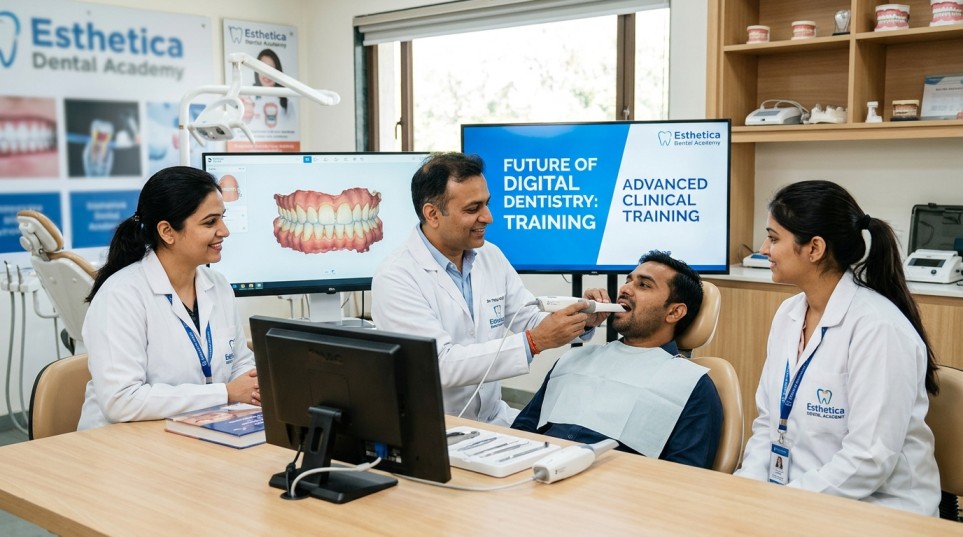
Located in the heart of Chandigarh, Esthetica Dental Academy is dedicated to bridging the critical gap between traditional clinical knowledge and modern digital innovation. Led by visionary experts like Prof. Dr. Sharad Arya, our academy is built on the philosophy that the best outcomes come from the marriage of clinical wisdom and technological prowess.
Our comprehensive curriculum is designed to help you:
Master the Digital Workflow: Learn to integrate scanning, virtual design, and 3D printing into your daily practice flow.
Implement Advanced Implantology: Understand how digital precision minimizes risks and maximizes success rates in implant placement.
Elevate Cosmetic Dentistry: Master the software tools required to craft flawless, natural-looking veneers and laminates that fit perfectly the first time.
The future of digital dentistry is not about discarding your hard-earned manual skills; it is about evolving them. By combining your clinical understanding with the power of digital tools, you can provide better, faster, and more predictable results for your patients, ensuring your practice remains a destination of choice.
Frequently Asked Questions (FAQ)
1. Is traditional dentistry becoming obsolete?
Not at all. The foundational principles of biology, anatomy, occlusion, and patient management remain the core of dentistry. However, digital tools allow you to apply those principles with far greater precision, reducing human error and improving patient outcomes.
2. Is it difficult for experienced dentists to switch to a digital workflow?
While there is a learning curve, modern digital workflows are designed to be highly intuitive. At Esthetica Dental Academy, we provide the structured, hands-on training necessary for experienced professionals to make a seamless transition without halting their practice operations.
3. Does the adoption of digital dentistry cost more?
While the initial investment in technology—such as scanners, software licenses, or milling machines—is significant, the long-term Return on Investment (ROI) is substantial. This is realized through increased patient satisfaction, fewer remakes, lower material costs, and higher treatment acceptance rates due to better visualization.
4. Can I learn digital dentistry if I only have a basic setup?
Yes, absolutely. You can start by learning digital diagnosis and planning, which are the most critical components of the digital workflow, before investing in heavy fabrication hardware like 3D printers or mills. Digital planning is the entry point for most clinics.
5. How does Esthetica Dental Academy help me stay ahead?
We offer specialized, advanced courses in General Dentistry, Implantology, and Endodontics that integrate the latest international research. Our goal is to ensure you are equipped with the exact technical skills most in demand by the patients of today and tomorrow.
The Path Forward
The transition to digital is not just a trend; it is the inevitable direction of the profession. As materials improve and software becomes more integrated, the barrier between what we want to achieve and what we can achieve will vanish.
Are you prepared to lead the future of digital dentistry? Do not let the digital revolution leave your practice behind. Enhance your clinical capabilities, increase your efficiency, and offer your patients the high-tech, precision care they deserve.
Join us at Esthetica Dental Academy and start your transformation today.